


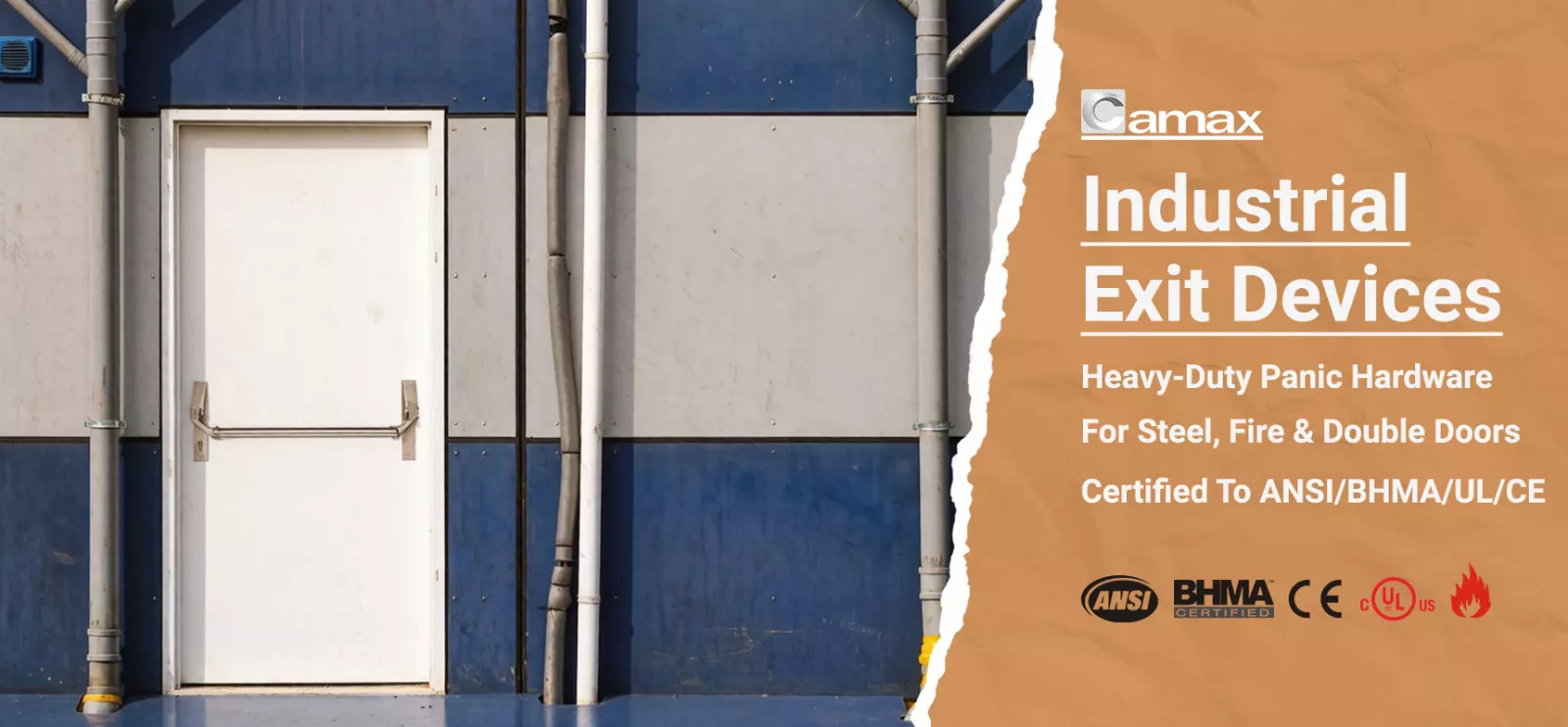
An industry door operates under very different conditions compared to doors found in offices or residential buildings. Industrial facilities such as factories, warehouses, logistics centers, and power plants rely on industrial steel doors, industrial metal doors, and industrial fire doors to protect people, equipment, and critical processes.
These environments often involve high occupancy, heavy machinery, forklifts, constant vibration, and elevated noise levels. Doors in such spaces are opened thousands of times a year and are frequently subjected to impact and misuse. This is why industrial door hardware must be stronger, more durable, and more reliable than standard commercial solutions.
In emergency situations, fast and intuitive egress is essential. This is where the industrial door hardware especially the industrial exit device and industrial panic bar become critical safety components, ensuring that industrial doors can be opened quickly and safely under pressure.
Table of contents
What Is an Industrial Exit Device?
A common question is: what is an exit device for an industrial door? An industrial exit device is a heavy-duty form of panic hardware specifically designed for industrial doors, including steel, metal, and fire-rated doors.
But not all exit devices are created equal. Standard commercial panic hardware is typically designed for light to moderate use, while industrial exit device hardware is engineered for a completely different performance.
Cycle life: Standard hardware may be rated for 250,000 cycles. Industrial-grade exit devices are often rated for 1,000,000+ cycles to match the demands of high-traffic industrial doors.
Force resistance: Industrial panic bars must withstand lateral forces from forklifts, carts, and accidental impacts that would destroy lighter hardware.
Material: Heavy-gauge steel or stainless steel construction is standard for industrial applications, not a premium upgrade.
Certifications: Genuine industrial-grade panic hardware carries third-party certifications (ANSI/BHMA, UL, CE, EN standards).
One-size-fits-all panic bars often fail in industrial environments. Industrial doors require industrial door panic hardware that can handle abuse, temperature changes, and continuous operation without compromising safety.
Why Do Industrial Doors Require Panic Hardware?
Industrial buildings present unique evacuation challenges. Workers may be wearing gloves, carrying tools, or operating near loud machinery. In these conditions, complex locking mechanisms can slow evacuation and increase risk.
This explains why industrial doors need panic hardware. An industrial emergency exit device provides a clear, simple action: push to exit. This intuitive operation is critical for safety-compliant panic hardware in industrial facilities.
1. Fire-Rated Exit Devices vs Regular Exit Devices
Not all panic bars are suitable for fire-rated doors. An industrial grade exit device for fire-rated door applications must be tested and certified as part of a fire door assembly. Using non-rated hardware on industrial fire doors is a common and serious mistake.
Fire-rated exit hardware must maintain door integrity during fire exposure while still allowing safe egress. This coordination between door, hardware, and frame explains why fire-rated exit hardware is important for industrial doors.
2. Heavy-Duty Design for High-Traffic Industrial Doors
Industrial doors often serve hundreds of users daily. A heavy-duty exit device is designed with reinforced latch mechanisms, thicker materials, and high-cycle testing to withstand extreme use.
For facilities with constant movement, an industrial exit device for high traffic doors ensures reliable performance without frequent maintenance or premature failure.
Types of Exit Devices for Industrial Doors
Camax manufactures a full range of exit devices for industrial doors. All Camax industrial exit devices are produced using stainless steel 304, certified to ANSI, BHMA, UL, CE, and fire rating standards. As a manufacturer, Camax focuses on engineering consistency, material quality, and long-term reliability rather than short-term cost reduction.
Camax supports OEM and ODM services, offering custom lengths, finishes, trims, and project-based solutions for factories, warehouses, and logistics facilities.
1. Rim Exit Devices for Industrial Steel Doors
A rim exit device for industrial steel door applications is one of the most common solutions. Rim devices are cost-effective, easy to maintain, and suitable for single industrial doors.
Camax manufactures rim exit devices in both touch bar and cross bar designs. Touch bar models are certified to ANSI/BHMA A156.3 Grade 1 and UL10C 3-hour fire rating, making them suitable for fire-rated single door installations. Half-length and full-length bars are available.
Camax’s cross-bar exit devices also meet EN1125, EN1634 1 and EN12211 standards, giving confidence in performance and safety.
- • CE & UL Listed Panic Touch Bar
- • Non-handed
- • Certificate: ANSI/BHMA A156.3 grade 1; UL10C, fire rated
- • Material: Stainless steel, Steel
- • Finish: Stainless steel satin, Silver painted, Polishing, PVD, Black, Red
- • Narrow Stile Door Exit Device
- • Non-handed
- • Compliance: ANSI/BHMA A156.3 grade 1; UL10C, 3-hour fire rating
- • Material: Stainless steel, Steel, Aluminum
- • Modular design, more than 4-point locks are available. Security anti-thrust latch.
- • Narrow Stile Crossbar Exit Device
- • Handed
- • Certificate: EN1125, categoery 3; EN1634-1, 2-hour fire rated
- • Optional: Pullman latch with invisible fixing screws
- • Material: Stainless steel, Steel, Plastic
- • Finish: Stainless steel satin, Silver painted, Polishing, PVD, Black, Red
- • Cross bar Exit Device
- • Non-handed
- • Suitable dor narrow stile door
- • Pullman latch, lateral latch modular design, with anti-thrust function
- • REX and LBM monitoring
- • Material: Stainless steel, Steel
- • Finish: Stainless steel satin, Silver painted, Polishing, PVD, Black, Red
2. Vertical Rod Exit Devices for Double Industrial Doors
For industrial double doors, vertical rod exit devices provide better sealing and are often preferred for fire door applications. Camax offers both surface-mounted vertical rod exit devices and concealed vertical rod exit devices for single and double industrial doors.
- • Concealed Vertical Rod Exit Device
- • Non-handed
- • Certificate: ANSI/BHMA A156.3 grade 1; UL10C, 3-hour fire rated
- • Material: Stainless steel, Steel, Aluminum
- • Finish: Stainless steel satin, Silver painted, Polishing, PVD, Black, Red
- • Concealed Vertical Rod Exit Device with Panic Bar
- • Non-handed
- • Certificate: EN1125; EN1634-1, fire-rated
- • Material: Stainless steel, Steel, Plastic
- • Finish: Stainless steel satin, Silver painted, Polishing, PVD, Black, Red
3. Mortise Exit Devices
A mortise exit device places the locking mechanism inside the door, rather than on the surface. This design delivers a cleaner appearance and enhanced security. Camax mortise panic hardware is suitable for interior industrial doors and steel fire doors, offering stable operation in demanding environments.
- • Heavy-Duty Panic Device
- • Non-handed
- • Certificate: ANSI/BHMA A156.3 grade 1; UL10C, 3-hour fire rated
- • Work with ANSI mortise locks.
- • Modular design, more than 4-point locks are available.
- • Security anti-thrust latch.
- • Touch Bar for Mortise Lock or Concealed Vertical Rod
- • Non-handed
- • Compliance: ANSI/BHMA A156.3 grade 1; UL10C fire rated; EN1125, EN1634-1 fire-rated
- • Work with Euro mortise locks complied to EN1125.
- • Material: Stainless steel, Steel.
4. Exterior Trim and Special Functions
Industrial exit devices can be equipped with exterior trim handles for controlled entry. Options such as key lockable panic bar for industrial exit door applications allow access control without compromising emergency egress.
| Image | Type | Certification | Feature | Hand | Material | |
|---|---|---|---|---|---|---|
| CMPA004/004B/006 | 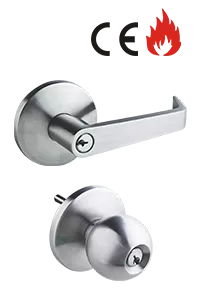 |
Lever & Rose Trim | EN1634-1, fire rated | CMPA004/006: with fixed cross shape spindle; CMPA004B: with spindle housing adaptor | Non-handed | Stainless steel; Steel |
| CMPA008/010 | 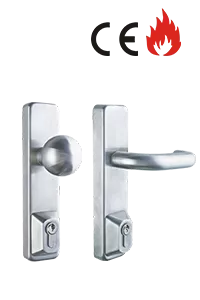 |
Escutcheon Trim | EN1634-1, fire rated | Cylinder can be changed on site | Non-handed | Stainless steel; Steel |
| CMPA012 |  |
Escutcheon Lever Trim | EN1634, fire rated | For narrow stile doors, Function 008, key locks & unlocks handle; Free wheeling, clutch design | Non-handed | Stainless steel 304 |
| CMPA401 | 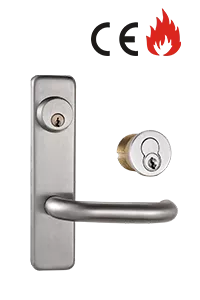 |
Escutcheon Trim | (Pending) UL 10C fire rated | Standard with ACY-28.6mm cylinder; SFIC cylinder is optional; Door thickness 44-50mm | Non-handed | Stainless steel; Steel |
| CMPA410 | 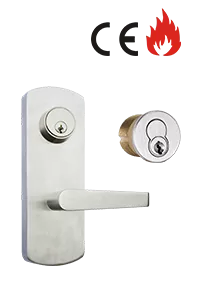 |
Escutcheon Trim | (Pending) UL fire rated | Standard with ACY-28.6mm cylinder; SFIC cylinder is optional; Door thickness 44-50mm | Non-handed | Stainless steel; Steel |
| CMPA450 Series | 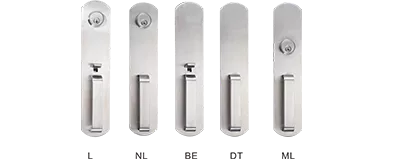 |
Pull & Thumbpiece Trim, Wide Stile | Trim has through-bolts to the device chassis for more security and durability. It fits 1-3/4" (44mm) door standard. | Non-handed | Finish: US3, US4, US10, US10B, US26, US26B & US32D |
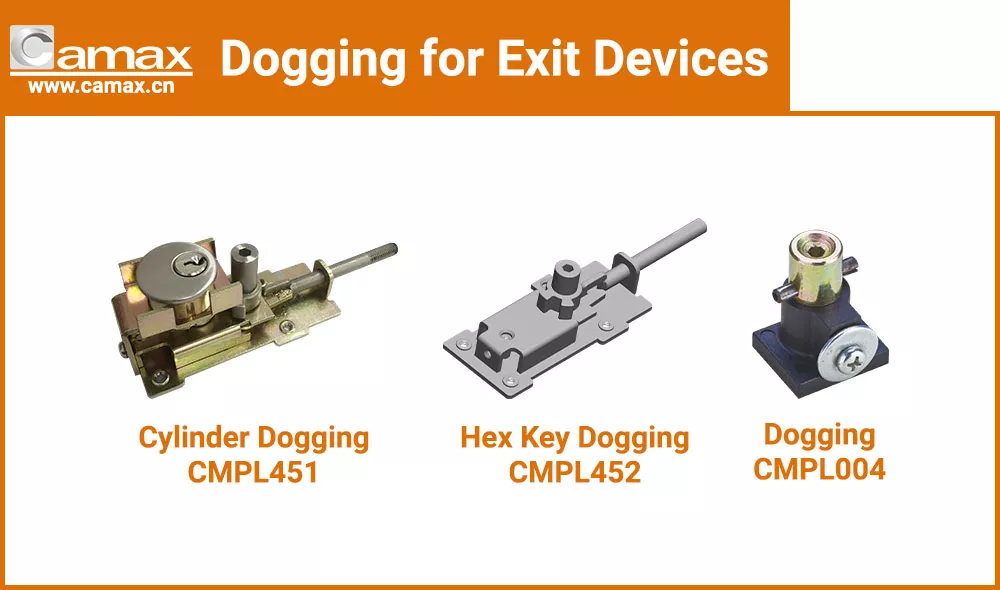
Another function worth understanding is dogging. On an exit device with a dogging feature, the latch can be held retracted, allowing the door to swing freely in both directions — useful during shift changes or delivery windows when a door sees constant two-way traffic. However, dogging is not permitted on fire-rated doors, so a key lockable panic bar for industrial exit doors must be used carefully and only where code allows. In fire-rated assemblies, electric dogging with a fire alarm integration is the appropriate solution.
How to Choose the Right Panic Bar for an Industrial Door
Selecting the correct panic hardware requires evaluating both the door and its environment. When deciding how to choose industrial panic bar solutions, consider the following factors:
Door material: steel, metal, or fire-rated construction
Single door or double industrial doors
Traffic frequency and user behavior
Interior or exterior exposure
Fire-rating and code compliance requirements
Need for dogging or keyed exterior control
For warehouses, choosing the best exit device for warehouse steel door installations often means prioritizing durability and certification over appearance.

Contact Camax to Get Reliable Industrial Exit Devices for Long-Term Safety
Door hardware in industrial settings takes a constant beating. Heavy use, large steel doors, and demanding environments quickly expose the limits of panic bars that are designed just to “pass.” When an emergency happens, reliability matters far more than minimum compliance. Choosing an industrial exit device that’s properly certified and built for real-world conditions helps ensure doors work exactly as they should, when every second counts.
Planning an industrial project—whether it’s a single warehouse exit or multiple factory doors—means thinking beyond the surface. Fire ratings, door materials, traffic levels, and code requirements all shape how an exit device will perform over time.
If you're working on a project and want to discuss technical specifications, custom lengths, OEM solutions, or simply figure out which exit device suits your door, contact Camax today. Camax works directly with contractors, architects, and facility managers.
Need help? Contact Camax for a quote!
Discover Camax's door & window hardware with ANSI/BHMA/UL/CE certification today!