

When a heavy industrial door fails, it rarely fails quietly. A hinge that's undersized, made from the wrong material, or simply not designed for your environment can cause downtime, safety incidents, and costly repairs. That's why choosing the right heavy-duty industrial hinges matters more than most people realize, especially in high-traffic facilities where doors cycle hundreds of times a day.
This guide walks through everything you need to make a confident purchasing decision: what industrial hinges actually are, how they compare to standard hardware, the different types available, and a step-by-step method for matching a hinge to your specific door and environment. Where relevant, we'll also share how Camax Hardware, a specialist manufacturer in this space, approaches each of these product categories.
Table of contents
What Are Heavy Duty Industrial Hinges?
At their core, industrial hinges are mechanical pivot components engineered to operate under conditions that would quickly wear out or outright break standard residential hardware. They're built to carry substantial door weights, endure frequent daily cycles, and hold up in environments where temperature swings, moisture, dust, and chemical exposure are part of the job.
You'll find heavy-duty industrial hinges installed on a wide range of applications: fire-rated factory doors, cold storage room access points, warehouse loading bay gates, heavy machinery enclosures, and large-scale outdoor security gates. In each case, the engineering requirement is the same: the hinge must remain functional and safe over a long service life, without routine maintenance creating operational headaches.
Tips:
Modern industrial door hinges for heavy doors are manufactured using precision machining and high-quality materials to ensure long service life. Reliable hinges improve safety, reduce maintenance costs, and support smooth daily operations.
Manufacturers such as Camax focus on producing dependable hinge solutions for industrial applications, offering both standard models and customized designs tailored to specific project requirements.
What Is the Difference Between Industrial and Standard Hinges?
The simplest answer: standard hinges are built for interior residential doors. Industrial hinges are built for everything else. But the practical differences go deeper than that, and they matter when you're specifying hardware for a commercial or industrial facility.
| Feature | Standard Hinges | Industrial Hinges |
|---|---|---|
| Load Capacity | Low (typically under 40 kg) | High (80 kg to 300 kg per hinge) |
| Durability | Moderate, designed for light use | Heavy-duty, built for frequent cycling |
| Primary Material | Steel, brass, or zinc alloy | Stainless steel 304/316, reinforced steel |
| Typical Application | Interior residential doors | Factories, warehouses, gates, equipment |
| Certifications | Rarely certified | CE, BHMA, UL fire-rated available |
| Expected Lifespan | Shorter, especially under heavy use | Significantly longer service life |
Industrial applications demand higher performance, especially when doors are large, heavy, or exposed to harsh environments. This is why selecting professional-grade heavy-duty stainless steel hinges is essential for long-term reliability.

Common Industrial Hinge Types Used in Doors, Gates, and Equipment
Understanding industrial hinge types is the foundation of any good specification process. Different doors, different environments, and different use patterns call for different hinge designs. Camax Hardware manufactures a comprehensive range of industrial door hardware and of industrial door hinges, each suited to specific applications.
1. 3D Adjustable Concealed Hinges for Modern Industrial Doors
3D adjustable concealed hinges are commonly used in commercial and industrial doors that require a clean appearance and precise alignment. These hinges allow adjustment in three directions, making installation easier and ensuring smooth operation.
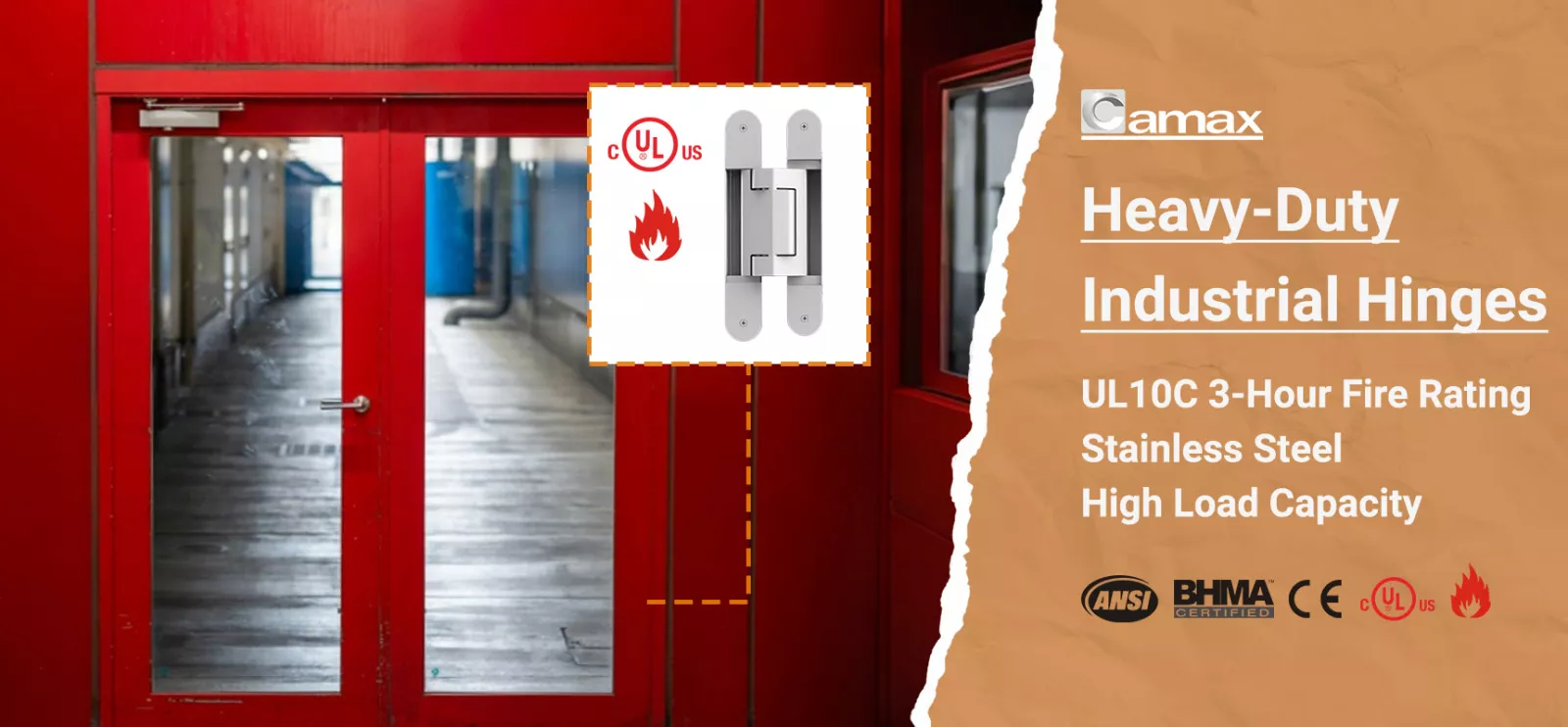
Camax produces concealed hinges with certified fire resistance performance and load capacity options ranging from 80 kg to 300 kg. Stainless steel construction improves durability and ensures consistent performance in demanding environments.
- • 3D adjustable invisible hinge
- • Non-handed
- • Certification: UL10C fire rated, 3 hours
- • Load capacity: 300kg
- • Suitable for wooden doors, steel doors, profile doors, folding doors
- • Minimum door thickness: 45mm
- • Material: Stainless steel 304
- • Finish: SS, PS, AB, PVD
- • 3D adjustable invisible hinge
- • Non-handed
- • Certification: UL10C fire rated, 3 hours
- • Certification (Pending): EN1935; EN1634-1, fire-rating
- • Load capacity: 200kg
- • Suitable for wooden doors, steel doors, profile doors, folding doors
- • Minimum door thickness: 45mm
- • Material: Stainless steel 304
- • Finish: SS, PS, AB, PVD
- • 3D adjustable invisible hinge
- • Non-handed
- • Certification: UL10C fire rated, 3 hours
- • Certification (Pending): EN1935; EN1634-1, fire-rating
- • Load capacity: 120kg
- • Suitable for wooden doors, steel doors, profile doors, folding doors
- • Minimum door thickness: 35mm
- • Material: Stainless steel 304
- • Finish: SS, PS, AB, PVD
- • 3D adjustable invisible hinge
- • Non-handed
- • Certification: UL10C fire rated, 3 hours
- • Certification (Pending): EN1935; EN1634-1, fire-rating
- • Load capacity: 60kg
- • Suitable for wooden doors, steel doors, profile doors, folding doors
- • Minimum door thickness: 35mm
- • Material: Stainless steel 304
- • Finish: SS, PS, AB, PVD
- • 3D adjustable invisible hinge
- • Non-handed
- • Certification: ANSI/BHMA A156.1, Heavy Weight Grade 1 (1 000 000 cycles); ANSI/BHMA A156.1, Double Weight (200 000 cycles); UL10C fire rated, 3 hours
- • Load capacity: 80kg
- • Suitable for wooden doors, steel doors, profile doors, folding doors
- • Minimum door thickness: 35mm
- • Material: Stainless steel 304
- • Finish: SS, PS, AB, PVD
2. Offset Pivots and Center Pivot Systems for Heavy Door Support
Pivot hinges distribute weight evenly across the door frame, making them suitable for large or high-traffic doors. These systems are frequently used in commercial entrances, steel doors, and industrial facilities.
Camax manufactures center pivots, bottom pivots, and intermediate pivots using stainless steel 304 material. These designs provide excellent strength and reliability for both wood and metal doors.
- • Offset pivot
- • Handed
- • Certificate: ANSI/BHMAA156.4, grade 1
- • Load capacity: 550 pounds (250KG)
- • Suitable for wooden doors and steel doors
- • Precision bearings for smooth operation with dust proof
- • Adjustable for 4.5mm in vertical direction
- • Material: Stainless steel 304
- • Center pivot, Non-handed
- • Compliance: ANSI/BHMAA156.4, grade 1; UL10C, 3-hour fire rating
- • Load capacity: 500lbs (250KG)
- • Suitable for wooden doors and steel doors
- • Precision bearings for smooth operation with dust proof
- • Minimum door thickness: 45mm
- • Material: Stainless steel 304
- • Intermediate pivot
- • Handed
- • Used with AD200
- • Vertical adjustment 4.5mm, including positive locking
- • Material: Stainless steel 304
- • Bottom pivot, Non-handed
- • Compliance: ANSI/BHMAA156.4, grade 1; UL10C, 3-hour fire rating
- • Load capacity: 500lbs (250KG)
- • Suitable for wooden doors and steel doors
- • Precision bearings for smooth operation with dust proof
- • Minimum door thickness: 45mm
- • Material: Stainless steel 304
3. Butt Hinges With Ball Bearing and Non-Ball Bearing Options
Butt hinges remain the most widely used solution in industrial environments. They are versatile, durable, and compatible with many door designs.
Camax offers both ball bearing and non-ball bearing versions, with certification across CE, BHMA, and UL standards, including fire-rated models. Ball bearing hinges are particularly suitable for heavy-duty industrial hinges that require smooth movement under high load conditions.
- • Certificate: EN1935; EN1634-1, fire rated for ball bearing butt hinges
- • Certificate: A156.1, grade 1&2; UL10C, 3 hours for butt hinges
- • Material: Stainless steel
- • Finish: SSS, PSS, PVD
Tip:
When selecting industrial hinges, always evaluate the expected usage frequency and environmental conditions to ensure optimal performance.
Why Choose Camax for Heavy Duty Industrial Hinges and Custom Manufacturing Services?
Camax is a professional manufacturer specializing in heavy-duty industrial hinges for demanding applications worldwide. With extensive experience in precision metal processing, the company delivers reliable hinge solutions for industrial doors, equipment, and customized engineering projects.
For buyers who need something beyond a standard catalog product, Camax offers full OEM and ODM support. That means a client can bring a specific door weight, environmental condition, or aesthetic requirement and receive a hinge engineered to match it. Customization options include:
Custom sizing to fit non-standard door frames
Load capacity engineering for doors exceeding standard ranges
Material selection, including stainless steel and carbon steel
Surface treatments for specific environmental conditions
Logo branding and custom packaging for distribution partners
All heavy-duty industrial hinges from Camax are produced using high-grade materials and undergo quality control processes aligned with international certification standards. Whether you're specifying hinges for a single project or sourcing at volume, Camax can accommodate both requirements.
How to Choose Heavy Duty Industrial Hinges for Your Application?
Many buyers ask how do I choose heavy duty industrial hinges or how do I know what hinge size I need. Selecting the correct hinge involves several technical considerations.
Step 1: Determine the Weight of the Door
This is the starting point for everything. Weigh the door slab, or get the weight from the manufacturer's spec sheet. The combined load capacity of all hinges must comfortably exceed this figure, with a safety margin. Never select a hinge at its rated limit.
Step 2: Select the Appropriate Material
Stainless steel 304 or 316 is ideal for corrosive, wet, or food-grade environments. Carbon steel works well in dry indoor industrial settings with a protective coating. Galvanized steel sits in the middle, offering decent corrosion resistance at a lower cost point.
Step 3: Match the Hinge Type to the Application
Consider door type (wood, steel, aluminum), how frequently the door cycles, and whether the hinge needs to be concealed. High-frequency doors benefit from ball-bearing designs. Tall heavy doors often do better with pivot systems.
Step 4: Evaluate Industrial Hinge Load Capacity
A standard installation uses three hinges per door. Divide the total door weight by the number of hinges and confirm each hinge's rated capacity exceeds that figure. Factor in dynamic loads from wind pressure or frequent opening force on gate applications.
Step 5: Choose the Correct Mounting Method
Weld-on mounting offers the strongest attachment and is common on steel gates and heavy frames. Bolt-on mounting is preferable when hinges may need replacement. Screw-on mounting suits wood door applications and lighter installations.
Why Stainless Steel Is Often the Best Choice for Industrial Use?
Among all material options, stainless steel consistently comes out on top for demanding industrial environments. Here's why procurement teams and engineers keep coming back to it:
Corrosion Resistance: Performs in wet, chemical, and salt-air environments without surface degradation over time.
Structural Strength: Maintains load capacity under continuous stress, thermal cycling, and mechanical impact.
Weather Resistance: Suitable for outdoor gate and door applications exposed to rain, humidity, and UV.
Hygienic Surface: Non-porous finish meets hygiene requirements in food processing and pharmaceutical facilities.
Low Maintenance: No routine painting or coating upkeep required. Reduces lifetime facility maintenance costs.
Long Service Life: Outlasts coated alternatives, especially in harsh environments, delivering better long-term value.
Industrial stainless steel hinges are particularly well-suited to food processing plants, marine-adjacent facilities, chemical factories, and any outdoor gate installation where rust resistance is non-negotiable. In these contexts, a small premium upfront pays back substantially over the service life of the installation.
Contact Camax Hardware to Specify Your Next Industrial Hinge Project
Selecting the right heavy duty industrial hinges is essential for maintaining safety, performance, and long term operational efficiency. From understanding industrial hinge types to evaluating industrial hinge load capacity, every detail contributes to reliable door performance in demanding environments.
Whether you are designing a new facility, upgrading equipment, or sourcing components for distribution, choosing high quality industrial door hinges ensures dependable operation and reduced maintenance costs.
Camax Hardware's engineering team is ready to help you select or develop the right heavy duty industrial hinges for your application, whether it's a standard catalog product or a fully custom solution. Contact Camax today to discuss your project requirements and receive a tailored solution designed for your application.
Need help? Contact Camax for a quote!
Discover Camax's door & window hardware with ANSI/BHMA/UL/CE certification today!