


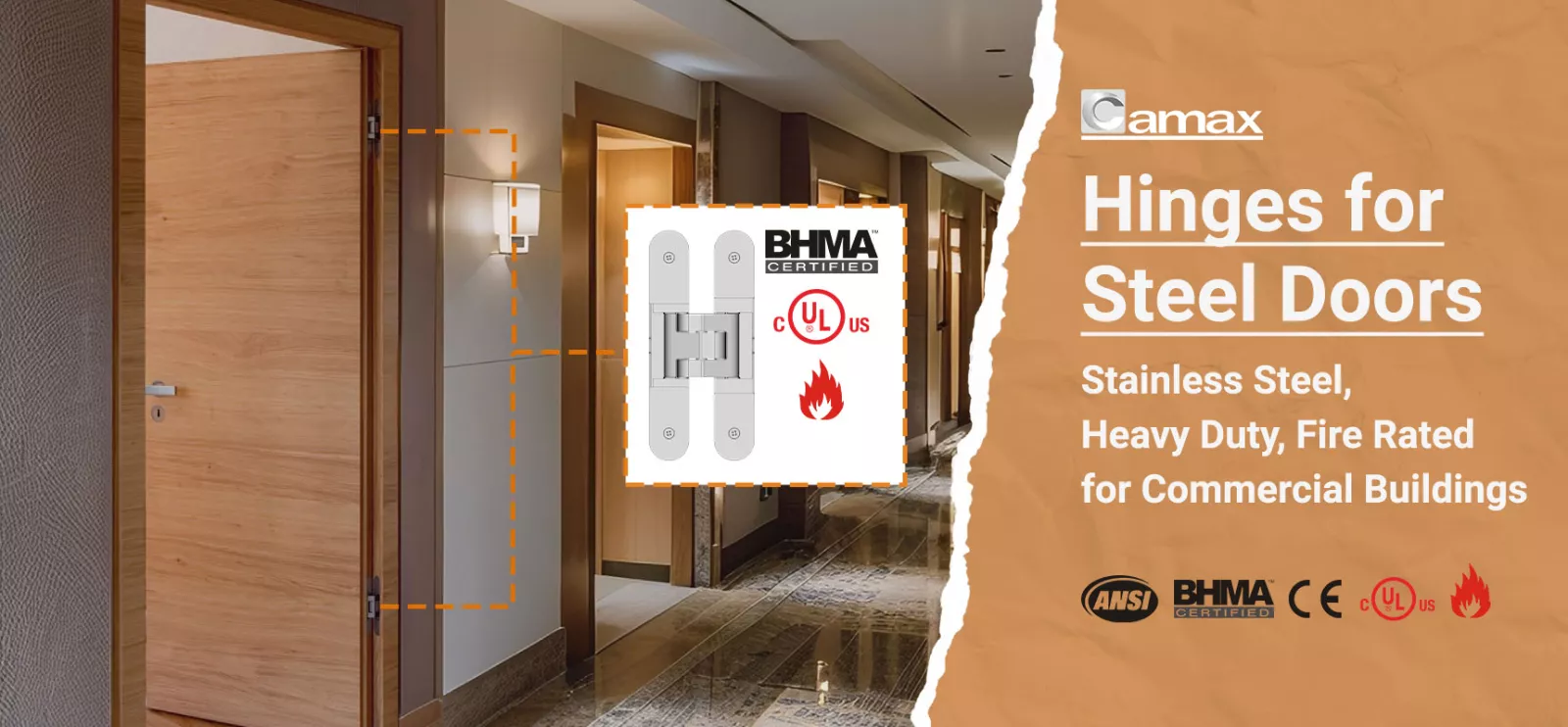
When it comes to installing or maintaining steel doors, one critical component often gets overlooked until problems arise: the hinges. Whether you're working on a commercial building, industrial facility, or high-security installation, selecting the appropriate hinge for steel door applications can mean the difference between a door that functions flawlessly for decades and one that becomes a maintenance headache.
In this comprehensive guide, we'll walk you through everything you need to know about stainless steel hinges heavy duty options, installation techniques, and how to choose the perfect door hinge for your specific application. Keep reading to ensure your steel door installation meets both safety standards and longevity expectations.
Table of contents
What Hinges Are Needed for a Steel Door?
Steel doors present unique challenges that standard residential door hardware simply cannot handle. The weight, frequency of use, and security requirements of these doors demand specialized solutions. Understanding what makes a proper hinge for steel door installations is the first step toward a successful project.
1. Why Heavy-Duty Hinges Matter for Steel Doors?
Every steel door installation requires heavy duty stainless steel door hinges. Why? Steel doors are much heavier than wooden doors. A typical wooden door weighs 50 to 80 pounds, but a commercial steel door can weigh 150 to 300 pounds or more. This extra weight puts constant pressure on hinges, so they need to be strong enough to handle the load without sagging or breaking.
Steel doors also get used more often than residential doors. A busy office entrance might open and close thousands of times each day. Standard hinges wear out quickly under this kind of heavy use. Heavy-duty hinges are built to last through millions of opening cycles.
Security matters too. Steel doors often protect important areas or serve as fire barriers. Security hinges for steel doors have special features like non-removable pins and reinforced construction that stop people from taking the door off its hinges.
2. What Is the Difference Between Standard and Heavy-Duty Hinges for Steel Doors?
The differences between standard and commercial steel door hinges are significant and affect how well your door works.
Material Strength: Standard hinges use lower-grade steel or zinc alloys. Heavy-duty hinges for steel security door applications use high-quality stainless steel that resists rust and corrosion. This is especially important for stainless steel hinges for exterior steel door installations exposed to weather, humidity, or salt air.
Reinforced Bearings: Standard hinges have simple friction bearings or no bearings at all. This causes squeaking and stiff operation. Ball bearing hinges for steel door applications have precision ball bearings that make the door swing smoothly and quietly, even with heavy use. Ball bearing stainless hinges for steel doors are popular in commercial buildings where smooth operation matters.
Quality: Heavy duty options have thicker metal, stronger joints, and better pins. Many include special features like extended barrels for better weight distribution or security studs that prevent forced entry.
Weight capacity: A standard residential hinge might hold 75 to 100 pounds. Industrial hinges for steel doors can support 200 to 400 pounds or more per hinge. This extra strength prevents failure and keeps your door working properly for years.
Tips: Important Consideration: Fire-Rated Hinges for Steel Doors
If your steel door is a fire barrier, you need fire-rated hinges. This is required by building codes when the door has a fire rating. Fire-rated steel door hinges are tested to stay strong during a fire. A fire door only works if all its parts can handle extreme heat. If standard hinges fail during a fire, the door won't stay closed, and fire and smoke can spread.
When selecting industrial hinges for steel doors, it is always better to overspec rather than underspec to prevent frame damage or hinge failure.
Camax Hardware provides fire door-rated hinges for steel door that meet strict safety and durability requirements for commercial projects.
Types of Hinges Used for Commercial Steel Doors
Commercial steel door applications offer several hinge style options, each with specific advantages for different situations. Understanding these options helps you select the best hinges for commercial steel door projects based on aesthetic preferences, functional requirements, and security needs.
1. Concealed Hinges
Concealed hinges have gained popularity in contemporary commercial architecture due to their clean aesthetic and enhanced security features. Unlike traditional hinges where the knuckles are visible when the door is closed, concealed hinges are completely hidden within the door and frame, creating a seamless appearance.
Camax Hardware manufactures premium 3D adjustable concealed hinges that represent the cutting edge of door hardware technology. These sophisticated hinges offer three-dimensional adjustment capabilities, allowing installers to fine-tune the door's position in height, depth, and lateral dimensions even after installation. This adjustability is invaluable for achieving perfect alignment and compensating for building settlement or seasonal changes.
- • 3D adjustable invisible hinge
- • Non-handed
- • Certification: UL10C fire rated, 3 hours
- • Load capacity: 300kg
- • Suitable for wooden doors, steel doors, profile doors, folding doors
- • Minimum door thickness: 45mm
- • Material: Stainless steel 304
- • Finish: SS, PS, AB, PVD
- • 3D adjustable invisible hinge
- • Non-handed
- • Certification: UL10C fire rated, 3 hours
- • Certification (Pending): EN1935; EN1634-1, fire-rating
- • Load capacity: 200kg
- • Suitable for wooden doors, steel doors, profile doors, folding doors
- • Minimum door thickness: 45mm
- • Material: Stainless steel 304
- • Finish: SS, PS, AB, PVD
- • 3D adjustable invisible hinge
- • Non-handed
- • Certification: UL10C fire rated, 3 hours
- • Certification (Pending): EN1935; EN1634-1, fire-rating
- • Load capacity: 120kg
- • Suitable for wooden doors, steel doors, profile doors, folding doors
- • Minimum door thickness: 35mm
- • Material: Stainless steel 304
- • Finish: SS, PS, AB, PVD
- • 3D adjustable invisible hinge
- • Non-handed
- • Certification: UL10C fire rated, 3 hours
- • Certification (Pending): EN1935; EN1634-1, fire-rating
- • Load capacity: 60kg
- • Suitable for wooden doors, steel doors, profile doors, folding doors
- • Minimum door thickness: 35mm
- • Material: Stainless steel 304
- • Finish: SS, PS, AB, PVD
- • 3D adjustable invisible hinge
- • Non-handed
- • Certification: ANSI/BHMA A156.1, Heavy Weight Grade 1 (1 000 000 cycles); ANSI/BHMA A156.1, Double Weight (200 000 cycles); UL10C fire rated, 3 hours
- • Load capacity: 80kg
- • Suitable for wooden doors, steel doors, profile doors, folding doors
- • Minimum door thickness: 35mm
- • Material: Stainless steel 304
- • Finish: SS, PS, AB, PVD
2. Pivot Hinges
When dealing with exceptionally heavy or oversized steel doors, pivot hinges offer engineering advantages that traditional hinges cannot match. Rather than hanging the door along its vertical edge, pivot hinges support the door's weight at the top and bottom, distributing loads more effectively for best hinges for heavy industrial steel door applications.
Camax offers a comprehensive range of pivot hinge solutions designed for demanding commercial and industrial applications. Their product line includes center pivots, which position the pivot point at the door's centerline for balanced operation; bottom pivots, which support the door's full weight at the floor level; offset pivots, which provide clearance for specific installation requirements; and intermediate pivots, which offer additional support points for extremely heavy or tall doors.
- • Offset pivot
- • Handed
- • Certificate: ANSI/BHMAA156.4, grade 1
- • Load capacity: 550 pounds (250KG)
- • Suitable for wooden doors and steel doors
- • Precision bearings for smooth operation with dust proof
- • Adjustable for 4.5mm in vertical direction
- • Material: Stainless steel 304
- • Center pivot, Non-handed
- • Compliance: ANSI/BHMAA156.4, grade 1; UL10C, 3-hour fire rating
- • Load capacity: 500lbs (250KG)
- • Suitable for wooden doors and steel doors
- • Precision bearings for smooth operation with dust proof
- • Minimum door thickness: 45mm
- • Material: Stainless steel 304
- • Intermediate pivot
- • Handed
- • Used with AD200
- • Vertical adjustment 4.5mm, including positive locking
- • Material: Stainless steel 304
- • Bottom pivot, Non-handed
- • Compliance: ANSI/BHMAA156.4, grade 1; UL10C, 3-hour fire rating
- • Load capacity: 500lbs (250KG)
- • Suitable for wooden doors and steel doors
- • Precision bearings for smooth operation with dust proof
- • Minimum door thickness: 45mm
- • Material: Stainless steel 304
3. Butt Hinges
Despite the emergence of newer hinge technologies, butt hinges remain the most common choice for hinges steel door installations, and for good reason. They offer proven reliability, straightforward installation, wide availability, and cost-effectiveness for standard applications.
Camax produces both ball-bearing and non-ball-bearing butt hinges manufactured from high-quality stainless steel. Their ball-bearing models incorporate precision bearings that ensure smooth, quiet operation even under heavy loads and frequent use, making them ideal for high-traffic commercial steel door hinges applications.
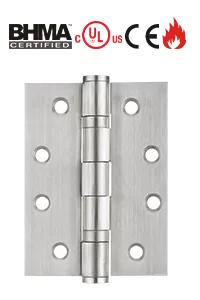
- • Certificate: EN1935; EN1634-1, fire rated for ball bearing butt hinges
- • Certificate: A156.1, grade 1&2; UL10C, 3 hours for butt hinges
- • Material: Stainless steel
- • Finish: SSS, PSS, PVD
How Many Hinges Does a Steel Door Need?
The number of hinges you need depends on your door's weight, height, and how often it gets used. For commercial steel doors up to 60 inches tall, use at least three hinges. This is the minimum, but many doors need more for better performance.
Doors between 60 and 90 inches tall should have four hinges. The extra hinge spreads the door's weight more evenly and reduces stress on each hinge. This helps your hardware last longer and keeps the door aligned properly. Doors over 90 inches tall often need five or more hinges.
Weight matters just as much as height. Even a shorter door that's very heavy (due to thick steel or fire-rated cores) may need extra hinges. Check each hinge's weight rating and make sure the total capacity of all hinges is well above your door's weight.
What Size Hinges Are Best for a Steel Door?
Choosing the right hinge size is important. Hinges that are too small will fail quickly. Oversized hinges cost more and can be harder to install. Hinge size has two measurements: height and width. Height is the vertical measurement when installed. Width is how far the hinge extends when opened flat. Common sizes for commercial steel doors are 4.5 x 4.5 inches, 5 x 4.5 inches, and 5 x 5 inches. Larger sizes are available for heavy or oversized doors.
Standard commercial steel doors (3 feet wide, 7 feet tall, 150 to 200 pounds) typically use 4.5 x 4.5 inch hinges. This size gives enough strength for most commercial applications. Heavy commercial doors (wider, taller, or heavier) often need 5 x 4.5 inch or 5 x 5 inch hinges for extra support.
Industrial or high-security steel doors may need even larger hinges, sometimes 6 x 6 inches or more. These doors require maximum strength, and larger hinges provide better load capacity and security.
How to Install Hinges on a Steel Door?
Installing hinges steel door hardware needs precision and the right tools. We recommend professional installation for commercial applications.
Mark hinge locations carefully. For three hinges, place the top one 7 inches from the top, the bottom one 11 inches from the bottom, and center the middle hinge. Space any additional hinges evenly.
Steel doors come with built-in hinge plates and pre-drilled holes. Check that your hinges align with these plates. Use only machine screws, never wood screws or self-tapping screws, as they won't hold properly.
Tighten screws gradually, alternating between them rather than finishing one at a time. This prevents binding and spreads pressure evenly.
Test the door after installation. It should swing smoothly with even gaps all around. If it binds or has uneven gaps, adjust the hinges.
For fire-rated doors, follow manufacturer instructions exactly and keep installation records. Improper installation can cancel fire certifications.
Tips: Professional Installation Matters
While understanding installation principles is valuable, commercial steel door hardware installation often requires specialized tools, expertise, and certification. Improper installation can compromise security, violate fire codes, void warranties, and create liability issues. Consider partnering with certified installation professionals for critical applications.
Contact Camax for Certified Heavy-Duty Hinges for Steel Doors
Selecting the appropriate hinge for steel door applications is a decision that impacts security, safety, functionality, and long-term costs. From understanding why heavy-duty stainless steel door hinges are essential to choosing between concealed, pivot, or butt hinge designs, every aspect of hinge selection contributes to your door system's overall performance.
Camax Hardware specializes in premium door hardware solutions designed specifically for demanding commercial, industrial, and institutional applications. Our comprehensive range includes 3D adjustable concealed hinges, various pivot hinge configurations, and both ball-bearing and non-ball-bearing butt hinges, all manufactured from high-quality stainless steel with available fire ratings and custom finishes.
For OEM, ODM, or bulk commercial orders, our team is ready to provide expert support and tailored solutions for your steel door systems. Contact Camax Hardware today to discuss your specific requirements.
Need help? Contact Camax for a quote!
Discover Camax's door & window hardware with ANSI/BHMA/UL/CE certification today!