


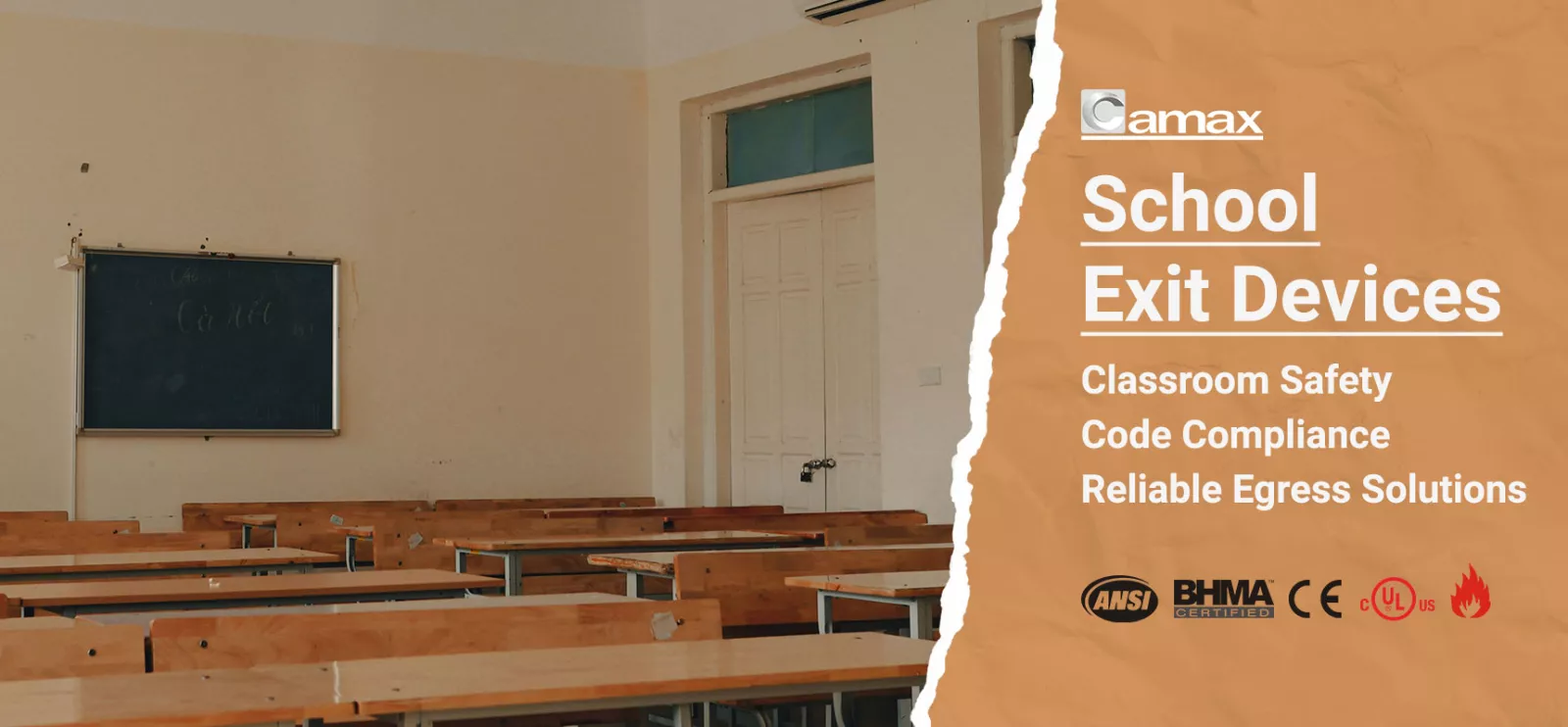
School buildings require a careful balance between everyday security and immediate emergency egress. A properly specified school exit device helps protect students, teachers, and staff by ensuring doors open quickly and intuitively during emergencies while remaining secure during normal operation. This article explains how school exit devices work, why they are required, and how to choose compliant solutions for different school door applications.
If you are involved in school construction, renovation, or safety upgrades, understanding school door hardware and classroom exit devices are essential. Keep reading to ensure your educational facility meets both safety codes and real-world security needs.
Table of contents
What Is a School Exit Device?
A school exit device, commonly known as a panic bar or crash bar, is specialized door hardware designed to allow quick, easy egress from a building during emergencies. Unlike regular door locks that require turning a knob or key, a school emergency exit device operates with simple pressure—anyone can push the horizontal bar to immediately unlock and open the door, even in panic situations.
Educational facilities face unique challenges that make proper exit hardware more critical than in most other buildings. Schools must accommodate high occupancy loads, ensure young children can operate exits intuitively, and balance security concerns with life safety requirements. This is why a specialized classroom exit device often includes features beyond what you'd find in a standard commercial panic bar.
1. The Critical Difference: Classroom vs Corridor Exit Hardware
Not all panic hardware for classrooms serves the same purpose. There's an important distinction between two main categories:
Classroom exit device: These typically feature what's called "classroom function" capability, allowing teachers to lock the door from inside for security while still maintaining free egress for occupants. A classroom door panic bar must never prevent someone from exiting, but it can control who enters from the corridor side.
Corridor fire exit hardware: Found on stairwell doors and main hallway exits, these focus purely on rapid evacuation. They're typically paired with automatic closing mechanisms and fire-rated door assemblies to compartmentalize fire and smoke.
The key attributes that make a school exit device effective are intuitive operation (push to exit), speed of egress (immediate release), and safety compliance (meeting fire codes and ADA requirements). Modern solutions also integrate security features without compromising the primary function: getting people out quickly when it matters most.

2. Why Schools Require Panic Hardware on Doors?
Schools typically have large numbers of occupants moving at the same time. In emergencies such as fires or other hazards, evacuation must be fast and orderly. This is why panic bars for school doors are widely required by building and fire codes.
High occupant density demands immediate door release.
Children benefit from push-to-exit operation with no training required.
School fire exit door hardware reduces the risk of blocked or locked exits.
By preventing doors from becoming obstacles, panic hardware significantly lowers the risk of injury during evacuations.
3. Classroom Exit Devices vs Standard Panic Bars
Not all panic hardware is the same. A standard panic bar provides free egress but limited control. In contrast, classroom panic hardware is designed to support both safety and security.
Standard panic bar: Focused on emergency exit only.
Classroom security exit device: Allows teachers to control outside access without blocking exit.
The innovation behind classroom function panic hardware addresses a real-world problem: how do you secure a classroom door during a lockdown without preventing occupants from escaping if needed? Traditional door locks often force a choice between security and safety. A classroom door lock with panic bar solves this dilemma elegantly.
How Does a Panic Bar Work in School Environments?
A panic bar works by retracting the latch or locking points when pressure is applied to the bar. In schools, this simple mechanical action ensures reliable performance even during power loss or high-stress situations.
1. Classroom Security and Lockdown Exit Devices
A classroom quick-release exit device with lockdown capability uses independent locking mechanisms for each side of the door. The panic bar's internal push mechanism remains permanently free—it cannot be locked or disabled from either side. However, the exterior trim includes a separate locking cylinder or thumb-turn that controls only whether the door can be opened from the corridor side. This means:
Students inside can always push the bar and exit
Teachers can lock the corridor side with a simple turn or key
Authorized staff can access the room with master keys
Fire codes remain satisfied because egress is never blocked
Inside locking for teachers typically takes one of two forms in classroom door hardware with exit device systems. The thumb-turn style allows teachers to simply rotate a small cylinder visible on the interior door frame, immediately securing the door without fumbling for keys. Key-operated interior cylinders provide additional security by requiring a physical key, though this adds a few seconds to lockdown procedures.
2. Fire-Rated and Code-Compliant School Exit Devices
When are exit devices required by code? Building codes specify several scenarios where panic hardware becomes mandatory in educational facilities:
Doors serving rooms with an occupant load of 50 or more people
Exits from high-hazard occupancy areas
Doors in the path of egress from assembly areas (gymnasiums, auditoriums)
Stairwell doors in multi-story school buildings
Main entrance/exit doors in many jurisdictions
A school fire exit door panic bar is designed to work with fire-rated doors, frames, and hardware as a complete system. Compliance is not just about the exit device itself, but the entire assembly.
EN1125 certified school panic device solutions for public buildings.
UL and CE certifications for international projects.
Clear distinction between panic hardware and fire exit hardware.
Fire-rated doors present special considerations for code compliant school exit device selection. When a door assembly carries a fire rating (typically 20, 45, 60, or 90 minutes), every component—including the panic hardware—must be compatible with that rating. You cannot simply install any panic bar on a fire-rated door; the device itself must be tested and listed for use on fire assemblies.
Tips:
Panic hardware allows controlled access in daily use, while fire exit hardware is typically used on escape routes that remain locked from the outside.
Exit Devices for Different School Door Types
School buildings include many door types, each with unique requirements. Camax Hardware manufactures a complete range of school exit devices for classroom doors and other school applications.
Camax offers rim exit devices, surface-mounted exit devices with vertical rods, concealed vertical rod exit devices, and multi point exit devices for school doors. Camax panic hardware is certified to ANSI, BHMA, UL and CE standards, demonstrating commitment to international quality and safety benchmarks. We manufacture devices using premium materials including stainless steel 304, steel, and aluminum, ensuring durability in demanding educational environments. Our hardware installs on both steel and wood doors, and dogging options are available for applications requiring temporary latch holdback. Multiple finish options allow coordination with existing door hardware and architectural aesthetics.
1. Rim Exit Devices
A rim exit device uses a surface-mounted locking body installed on the door face, paired with a horizontal push bar for easy operation. Pressing the bar retracts the latch directly into the device housing, releasing the door instantly. The latch engages with a strike fixed to the frame, providing secure closure while maintaining fast, intuitive egress.
A rim exit device uses a surface-mounted locking body installed on the door face, paired with a horizontal push bar for easy operation. Pressing the bar retracts the latch directly into the device housing, releasing the door instantly. The latch engages with a strike fixed to the frame, providing secure closure while maintaining fast, intuitive egress.
- • CE & UL Listed Panic Touch Bar
- • Non-handed
- • Certificate: ANSI/BHMA A156.3 grade 1; UL10C, fire rated
- • Material: Stainless steel, Steel
- • Finish: Stainless steel satin, Silver painted, Polishing, PVD, Black, Red
- • Narrow Stile Door Exit Device
- • Non-handed
- • Compliance: ANSI/BHMA A156.3 grade 1; UL10C, 3-hour fire rating
- • Material: Stainless steel, Steel, Aluminum
- • Modular design, more than 4-point locks are available. Security anti-thrust latch.
- • Narrow Stile Crossbar Exit Device
- • Handed
- • Certificate: EN1125, categoery 3; EN1634-1, 2-hour fire rated
- • Optional: Pullman latch with invisible fixing screws
- • Material: Stainless steel, Steel, Plastic
- • Finish: Stainless steel satin, Silver painted, Polishing, PVD, Black, Red
- • Cross bar Exit Device
- • Non-handed
- • Suitable dor narrow stile door
- • Pullman latch, lateral latch modular design, with anti-thrust function
- • REX and LBM monitoring
- • Material: Stainless steel, Steel
- • Finish: Stainless steel satin, Silver painted, Polishing, PVD, Black, Red
2. Vertical Rod Exit Devices
For double exit doors where clean lines or frame limitations make surface-mounted hardware impractical, vertical rod exit devices offer a reliable alternative. Instead of relying on a single latch point, these systems secure the door using rods that run internally toward the top and bottom of the door. Activating the push bar withdraws both rods at the same time, disengaging the strikes in the head and floor and allowing the door to open smoothly in an emergency.
Camax designs and manufactures vertical rod exit devices tailored for commercial double-door assemblies and concealed locking requirements. Each system delivers dependable two-point latching, with accurately machined components built to handle extensive daily use. Fire-rated options are available for assemblies up to three hours, along with flexible configurations for single or paired doors and a wide selection of trims to suit different architectural and functional needs.
- • Concealed Vertical Rod Exit Device
- • Non-handed
- • Certificate: ANSI/BHMA A156.3 grade 1; UL10C, 3-hour fire rated
- • Material: Stainless steel, Steel, Aluminum
- • Finish: Stainless steel satin, Silver painted, Polishing, PVD, Black, Red
- • Concealed Vertical Rod Exit Device with Panic Bar
- • Non-handed
- • Certificate: EN1125; EN1634-1, fire rated
- • Material: Stainless steel, Steel, Plastic
- • Finish: Stainless steel satin, Silver painted, Polishing, PVD, Black, Red
3. Mortise Exit Devices
When a project calls for enhanced security without compromising emergency egress, mortise exit devices stand out as the preferred solution for steel doors. Instead of relying on surface-mounted components alone, the exit function is built directly into a mortise lock installed inside the door, creating a more integrated and tamper-resistant assembly.
Camax Hardware engineers mortise exit devices for environments where controlled access and life safety must work together. Our designs incorporate reinforced lock cases and advanced latching configurations that support higher security demands, while still delivering smooth, code-compliant panic operation. This balance makes Camax mortise systems well-suited for commercial buildings, educational facilities, and other high-risk locations.
- • Heavy-Duty Panic Device
- • Non-handed
- • Certificate: ANSI/BHMA A156.3 grade 1; UL10C, 3-hour fire rated
- • Work with ANSI mortise locks.
- • Modular design, more than 4-point locks are available.
- • Security anti-thrust latch.
- • Touch Bar for Mortise Lock or Concealed Vertical Rod
- • Non-handed
- • Compliance: ANSI/BHMA A156.3 grade 1; UL10C fire rated; EN1125, EN1634-1 fire-rated
- • Work with Euro mortise locks complied to EN1125.
- • Material: Stainless steel, Steel.
Camax supports OEM and ODM school exit device solutions, including custom classroom functions, finishes, and project-specific adaptations.
Installation, Maintenance, and Safety Checks of School Exit Devices
Correct installation and regular maintenance are essential for long-term safety. When installing classroom door lock with panic bar hardware, use the manufacturer's template carefully. Camax provides detailed installation instructions and full-size templates with all devices. Deviating from specified dimensions or hole locations can result in binding mechanisms or premature hardware failure.
How to install exit device on school door: Follow manufacturer templates and alignment guidelines.
Avoid improper door prep that can affect latching.
Inspect panic bars annually for wear or loose components.
Check compliance with current safety standards and ADA requirements.
Routine inspections help ensure that school exit door panic hardware performs correctly when it is needed most.
Contact Camax Hardware to Choose the Right School Exit Devices
Selecting and maintaining appropriate school exit device hardware represents a fundamental responsibility in educational facility management. From standard panic bar for school exit doors to specialized classroom security function panic hardware, each device serves a critical role in protecting students and staff during emergencies while providing necessary security during normal operations.
For school projects requiring reliable, certified, and durable exit hardware, Camax Hardware offers a complete range of school exit devices and classroom exit devices with OEM and ODM support. Contact Camax today to discuss your project requirements, technical specifications, and long-term supply solutions.
Need help? Contact Camax for a quote!
Discover Camax's door & window hardware with ANSI/BHMA/UL/CE certification today!