


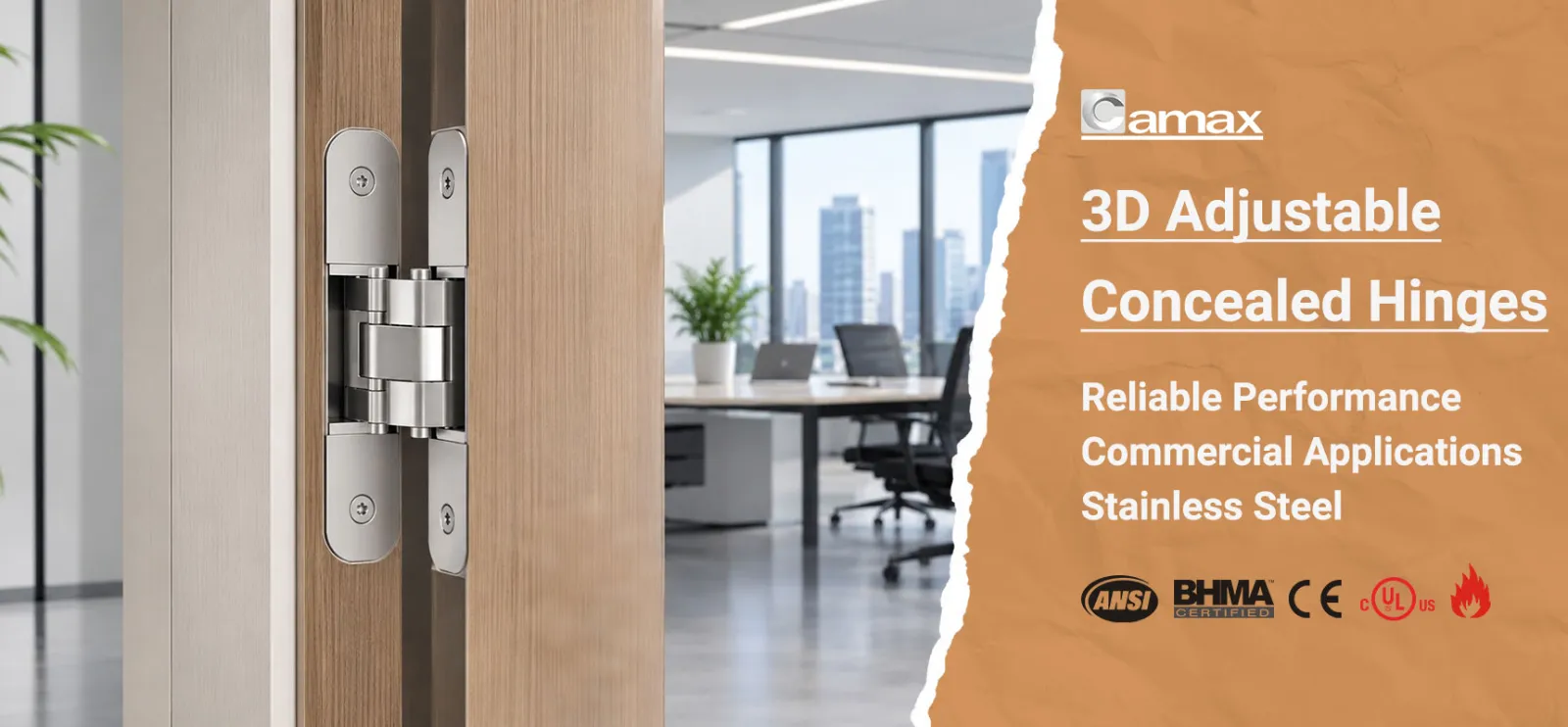
A well-fitted door should open smoothly, close properly and maintain even gaps around its edges. Getting that alignment right can be challenging, particularly with heavy commercial doors or installations where a clean, uninterrupted appearance matters. A 3D adjustable concealed hinge addresses these requirements by combining hidden installation with adjustment in three directions. It allows installers to fine-tune door positioning without relying entirely on repositioning the hinge or modifying the frame. For door manufacturers, distributors and project contractors, understanding how these hinges work is essential when selecting hardware for modern architectural and commercial doors.
Table of contents
What Is a 3D Adjustable Concealed Hinge?
A 3D adjustable concealed hinge is a door hinge fitted within the door leaf and frame, keeping most of the hinge mechanism out of sight when the door is closed. Unlike conventional visible butt hinges, it maintains a cleaner appearance while providing mechanical support for the door. Its defining feature is the ability to adjust the door position along three axes after installation, subject to the adjustment range of the specific model.
1. What Does 3D Adjustable Mean on a Hinge?
The term "3D adjustable" refers to three independent adjustment directions: height, side and depth. These settings help correct differences in door alignment and maintain consistent clearances between the door and frame. A 3D adjustable hinge therefore offers more installation flexibility than a concealed hinge with limited or no adjustment.
2. How Does a 3D Adjustable Concealed Hinge Work?
The concealed door hinge connects the door leaf to its frame through a concealed mechanical assembly. Depending on its construction, adjustment screws or dedicated mechanisms control the position of the door in each direction. Installers can use the specified adjustment points and tools to make small corrections while the hinge remains fixed in its prepared recesses.
This arrangement is particularly useful when a door settles slightly after installation or when minor alignment corrections are needed during commissioning. The exact adjustment procedure and available range differ between hinge designs, so the manufacturer's instructions should always be followed.
3. What Are the Advantages of 3D Concealed Hinges?
Clean appearance: The hinge mechanism is concealed when the door is closed, supporting minimalist and flush-door designs..
Precise alignment: Three-direction adjustment helps correct uneven gaps and positioning issues..
Installation flexibility: Fine adjustments can reduce the need for repeated removal and repositioning..
Application versatility: Different models are available for various door materials, dimensions and weight requirements..
Long-term convenience: Where the design permits, installers can correct minor alignment changes after installation..
How Does 3D Adjustment Work?
The three adjustment axes address different alignment problems. Understanding each one makes it easier to select and install the right 3D adjustable door hinge.

1. Height Adjustment (Vertical Adjustment)
Height adjustment moves the door upward or downward relative to the frame. It is useful when the clearance beneath the door is uneven or when the door position needs to be corrected to prevent contact with the floor. The 3D adjustable concealed hinge height adjustment mechanism allows installers to make these corrections within the manufacturer's specified range.
2. Side Adjustment (Horizontal Adjustment)
Side adjustment shifts the door laterally, helping maintain consistent gaps along the hinge side and lock side. If a door sits too close to one side of the frame, the 3D adjustable concealed hinge side adjustment mechanism can help restore the intended position without relocating the entire hinge assembly.
3. Depth Adjustment
Depth adjustment changes how far the door sits inward or outward relative to the frame. This is important for flush installations, where the door surface should align neatly with the surrounding frame or wall. Proper 3D adjustable concealed hinge depth adjustment also helps achieve the intended closing position and appearance.
Installation note:
Not all concealed hinges use the same adjustment mechanism. Check the model-specific instructions before turning adjustment screws. Exceeding the specified adjustment range can affect hinge performance or damage its components.
Camax 3D Adjustable Concealed Hinges: OEM and ODM Manufacturing Solutions
Camax manufactures mechanical and electrified door hardware, including stainless steel 3D adjustable concealed hinges for commercial and architectural applications. With manufacturing experience since 2006, the company provides OEM and ODM services to meet different customer and project requirements. Its concealed hinge range offers SS304 and SS316 stainless steel options, selected according to the installation environment, corrosion-resistance requirements and project specifications.
These hinges are suitable for applications such as commercial buildings, hotels and offices where concealed installation and reliable mechanical performance are important. For commercial and heavy-duty doors, Camax provides concealed hinges with different load-capacity options. When selecting an 80 kg or 120 kg hinge, you should verify the rated configuration, number of hinges, door dimensions and test conditions to ensure suitability.
Camax also supports customized hinge manufacturing for door manufacturers, hardware distributors and project suppliers. OEM production can follow customer drawings, samples or existing specifications, while ODM cooperation covers product development based on project needs and manufacturing feasibility. Customization may include dimensions, structural details, technical specifications, stainless steel grades and surface finishes, depending on model availability and production capabilities.
- • 3D adjustable invisible hinge
- • Non-handed
- • Certification: UL10C fire rated, 3 hours
- • Load capacity: 300kg
- • Suitable for wooden doors, steel doors, profile doors, folding doors
- • Minimum door thickness: 45mm
- • Material: Stainless steel 304
- • Finish: SS, PS, AB, PVD
- • 3D adjustable invisible hinge
- • Non-handed
- • Certification: UL10C fire rated, 3 hours
- • Certification (Pending): EN1935; EN1634-1, fire-rating
- • Load capacity: 200kg
- • Suitable for wooden doors, steel doors, profile doors, folding doors
- • Minimum door thickness: 45mm
- • Material: Stainless steel 304
- • Finish: SS, PS, AB, PVD
- • 3D adjustable invisible hinge
- • Non-handed
- • Certification: UL10C fire rated, 3 hours
- • Certification (Pending): EN1935; EN1634-1, fire-rating
- • Load capacity: 120kg
- • Suitable for wooden doors, steel doors, profile doors, folding doors
- • Minimum door thickness: 35mm
- • Material: Stainless steel 304
- • Finish: SS, PS, AB, PVD
- • 3D adjustable invisible hinge
- • Non-handed
- • Certification: UL10C fire rated, 3 hours
- • Certification (Pending): EN1935; EN1634-1, fire-rating
- • Load capacity: 60kg
- • Suitable for wooden doors, steel doors, profile doors, folding doors
- • Minimum door thickness: 35mm
- • Material: Stainless steel 304
- • Finish: SS, PS, AB, PVD
- • 3D adjustable invisible hinge
- • Non-handed
- • Certification: ANSI/BHMA A156.1, Heavy Weight Grade 1 (1 000 000 cycles); ANSI/BHMA A156.1, Double Weight (200 000 cycles); UL10C fire rated, 3 hours
- • Load capacity: 80kg
- • Suitable for wooden doors, steel doors, profile doors, folding doors
- • Minimum door thickness: 35mm
- • Material: Stainless steel 304
- • Finish: SS, PS, AB, PVD
Tips: Why Work with Camax?
Camax focuses on door hardware manufacturing rather than simply supplying individual components. Its product portfolio includes panic exit devices, mortise locks, concealed hinges, cylinders and door handles. This broader manufacturing experience helps Camax understand the requirements of complete commercial door hardware systems.
For customers sourcing 3D adjustable concealed hinges, Camax offers direct communication on product specifications, material selection and customization. Technical drawings, product information and relevant test documentation can be discussed during the product evaluation process.
What Types of Doors Can Use 3D Adjustable Concealed Hinges?
A 3D adjustable concealed hinge is not automatically suitable for every door. Compatibility depends on the hinge design, door construction, available installation space, fixing method and required load capacity.
1. 3D Adjustable Concealed Hinges for Wooden Doors
Wooden doors are a common application for concealed hinges, particularly in hotels, offices and high-end residential buildings. A 3D adjustable concealed hinge for wooden doors helps achieve a flush appearance while allowing installers to correct alignment after fitting. The door leaf and frame must provide sufficient material and structural support for the selected hinge and its fixing points.
2. 3D Adjustable Concealed Hinges for Aluminum Doors
Aluminum doors often have narrower profiles and different internal structures from wooden doors. A 3D adjustable concealed hinge for aluminum doors must therefore be compatible with the profile dimensions, reinforcement and available fixing arrangements. Before selection, check the hinge body dimensions and the manufacturer's installation requirements.
3. 3D Adjustable Concealed Hinges for Steel Doors
Steel doors are frequently used in commercial and industrial environments. Selecting a 3D adjustable concealed hinge for steel doors requires attention to mounting structure, reinforcement, door weight and the preparation of the hinge recesses. Fire-rated applications also require verification that the hinge is approved for the specific door assembly.
4. 3D Adjustable Concealed Hinges for Hidden and Flush Doors
Hidden doors are designed to blend into surrounding walls or architectural finishes. Because the hinge is not visible when the door is closed, adjustable hidden door hinges are often considered for these installations. Three-direction adjustment helps installers achieve a more consistent relationship between the door surface, frame and surrounding wall. The hinge's opening angle and available adjustment range should be checked against the design requirements.
How Much Weight Can a 3D Adjustable Concealed Hinge Support?
Load capacity is one of the most important specifications when choosing a concealed hinge. However, the rated weight should never be considered in isolation. Door height, width, thickness, material, weight distribution, hinge spacing and fixing strength all influence the actual performance of the installation.
Always check whether the manufacturer's stated load capacity applies to one hinge or a complete hinge set. Testing conditions and installation configurations also matter when comparing different products.
An 80 kg 3D adjustable concealed hinge and a 120 kg 3D adjustable concealed hinge serve different load requirements. The higher-rated option may be appropriate for heavier door assemblies, provided the door structure, frame and fixing arrangement are also suitable. These figures should be compared using the same rating and testing basis rather than treated as interchangeable product specifications.
The number of hinges required depends on door dimensions, weight, construction and the manufacturer's recommendations. Two hinges may be sufficient for some smaller doors, while taller or heavier doors may require three or more. The rated capacity of a hinge set, rather than simply multiplying an individual hinge rating, should guide selection.
Tips: Are 3D Adjustable Concealed Hinges Suitable for Heavy Doors?
Yes, certain heavy-duty 3D adjustable concealed hinges are designed for heavier commercial doors. However, not every concealed hinge is intended for this purpose. Check the model's tested load capacity, fixing requirements and suitability for the door material. For demanding projects, consult the manufacturer before finalizing the hardware specification.
What Is the Difference Between a 3D Adjustable Concealed Hinge and a Regular Hinge?
1. Concealed Hinges vs. 3D Adjustable Concealed Hinges
A concealed hinge describes how the hinge is installed: its mechanism is hidden when the door is closed. A 3D adjustable concealed hinge is a more specific type that combines this hidden installation with three-direction adjustment. In other words, not every concealed hinge provides 3D adjustment.
2. 3D Adjustable Concealed Hinges vs. Standard Door Hinges
Standard visible butt hinges are generally mounted on the door edge and frame, leaving part of the hinge visible. They are widely used because of their straightforward construction and installation. A 3D adjustable concealed hinge, by comparison, requires prepared recesses in the door and frame but offers a cleaner appearance and additional alignment control.
| Comparison | Standard Butt Hinge | 3D Adjustable Concealed Hinge |
|---|---|---|
| Appearance | Visible when installed | Hidden when door is closed |
| Adjustment | Depends on hinge design | Height, side and depth |
| Installation | Usually surface-mounted or recessed | Requires prepared door and frame recesses |
| Typical consideration | Simplicity and conventional use | Appearance and precise alignment |
3. What Is a 180-Degree Concealed Hinge?
A 180-degree concealed hinge is designed to allow the door to open up to approximately 180 degrees under its specified installation conditions. This can be useful where a wide opening is required or where the door needs to sit close to the adjacent wall when fully open.
However, a 180-degree opening angle is not a standard feature of every 3D adjustable hinge. When searching for a 3D adjustable concealed hinge 180 degree, check the manufacturer's specified opening angle, door-frame geometry and any clearance restrictions. The actual opening movement can be affected by the door, frame and surrounding construction.
Contact Camax to Choose the Right 3D Adjustable Concealed Hinge for Your Project
A suitable concealed hinge should match the door's construction, weight and intended use. Before purchasing, confirm the three-dimensional adjustment range, hinge dimensions, opening angle, material and rated load capacity. For commercial and heavy-duty installations, fixing strength and compatibility with the complete door assembly deserve particular attention.
Camax manufactures stainless steel 3D adjustable concealed hinges and provides OEM and ODM services for door manufacturers, hardware distributors and project suppliers. Whether you need an existing model or a customized solution based on your drawings and specifications, Camax can work with your team to evaluate the appropriate product configuration.
Looking for a 3D Adjustable Concealed Hinge Manufacturer?
Contact Camax to discuss your concealed hinge requirements, including SS304 or SS316 material options, load capacity, door applications and OEM/ODM customization. Our team can provide product information and work with you on a suitable solution for your door hardware range or project.