


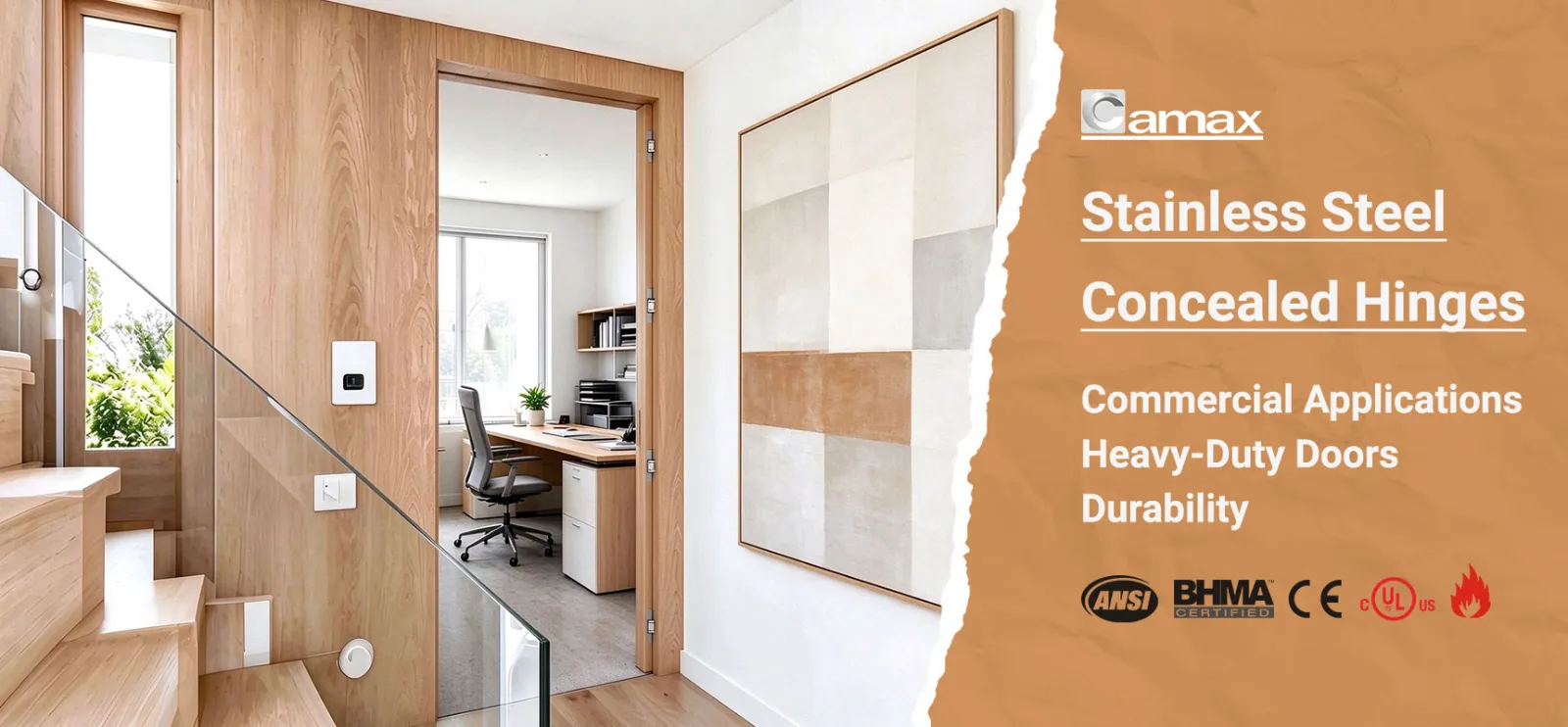
A door hinge affects more than how a door opens. It also influences alignment, long-term reliability and the finished appearance of the installation. For commercial buildings and modern architectural projects, stainless steel concealed door hinges offer a practical combination of hidden installation, corrosion resistance and durable construction.
Unlike traditional butt hinges, concealed hinges sit inside recesses in the door and frame, leaving the hinge mechanism largely out of sight when the door is closed. The result is a cleaner appearance without abandoning the adjustment needed for accurate door alignment.
Material selection deserves the same attention as hinge design. Stainless steel and zinc alloy concealed hinges may serve similar purposes, but their suitability can differ according to the environment, expected service life and project requirements. Camax manufactures concealed door hardware and provides OEM and ODM services for customers developing products for different door applications.
Table of contents
What Are Stainless Steel Concealed Door Hinges?
Stainless steel concealed hinges are door hinges designed to be recessed into the door leaf and frame. When the door is closed, most of the mechanism remains hidden, making them suitable for contemporary interiors, flush doors and commercial spaces where visible hardware is kept to a minimum.
Traditional hinges usually expose their knuckles and hinge barrels. Concealed hinges use a linked mechanism inside the door and frame to control the opening movement. Depending on the model, the mechanism may incorporate multiple pivot points, connecting arms and adjustable mounting sections.
1. How Do Stainless Steel Concealed Hinges Work?
When the door opens, the internal linkage guides the door leaf through its intended movement. Once closed, the mechanism returns into its recessed position. This arrangement allows the door to retain a relatively uninterrupted surface while supporting repeated operation.
Many architectural models provide three-dimensional adjustment. Installers can correct the door's vertical position, horizontal position and depth within the limits specified by the manufacturer. This is particularly useful when a heavy door needs fine alignment after installation or when minor adjustments are required during building use.
The mechanism, adjustment range and load rating vary by model. A concealed hinge should therefore be selected according to the actual door construction rather than appearance alone.
Key point:
Stainless steel concealed hinges combine a hidden hinge mechanism with the properties of stainless steel. Their actual performance still depends on material grade, hinge construction, mounting conditions and correct installation.
Why Choose Stainless Steel Concealed Hinges Instead of Zinc Alloy?
Zinc alloy is widely used for decorative hardware and cost-sensitive applications. Stainless steel is often worth considering when corrosion resistance, mechanical performance and long-term reliability carry greater weight in the purchasing decision.
| Comparison Factor | Stainless Steel Concealed Hinges | Zinc Alloy Concealed Hinges |
|---|---|---|
| Corrosion Resistance | Generally good, depending on the grade and exposure conditions. | Depends on alloy composition, protective finish and coating condition. |
| Mechanical Performance | Can provide strong mechanical properties when appropriately designed. | Depends on the alloy, casting design and load-bearing components. |
| Maintenance | May require less corrosion-related maintenance in suitable environments. | Protective finishes may need closer attention if damaged or exposed. |
| Initial Cost | Often higher, depending on grade and construction. | Often attractive for projects with tighter initial budgets. |
| Typical Selection Priority | Durability, corrosion resistance and demanding applications. | Decorative flexibility and cost-sensitive applications. |
1. Corrosion Resistance and Long-Term Durability
Stainless steel contains chromium, which helps form a passive surface layer that resists corrosion. This makes suitable stainless steel grades a practical choice for humid indoor environments and other applications where ordinary protective coatings may be vulnerable to damage.
For buyers specifying corrosion-resistant stainless steel concealed hinges, the grade matters. Surface contamination, chloride exposure, cleaning chemicals and poor maintenance can still cause corrosion. Stainless steel should not be described as completely immune to rust.
2. A Cleaner Appearance and Reliable Adjustment
Concealed installation suits minimalist interiors, flush doors and architectural projects where visible hinge hardware would interrupt the design. Stainless steel hidden hinges combine this discreet appearance with a material suitable for a broad range of commercial applications.
Three-dimensional adjustment is another useful feature where offered. It allows installers to fine-tune the door position without relying entirely on repositioning the mounting points. Adjustment capability, however, does not replace correct machining or adequate support from the door and frame.
3. Is 304 or 316 Stainless Steel Better for Concealed Hinges?
The difference between 304 and 316 stainless steel concealed hinges lies mainly in their alloy composition and resistance to particular corrosive environments. Both grades contain chromium and nickel, while 316 also contains molybdenum, which improves resistance to chloride-related corrosion.
304 stainless steel: A common choice for many indoor commercial applications and environments with moderate exposure to moisture.
316 stainless steel: Often preferred for coastal locations and environments where chloride exposure makes greater corrosion resistance important.
For stainless steel concealed hinges for exterior doors, consider local climate, rain exposure, airborne salt and maintenance conditions before selecting a grade. A sheltered entrance and a door beside the sea do not face the same corrosion risks.
Grade selection should also reflect the project budget and expected service conditions. Neither 304 nor 316 eliminates the need for suitable cleaning, installation and maintenance.

How Do You Choose Concealed Hinges for Heavy Doors?
Selecting stainless steel concealed hinges for heavy doors requires more than matching the stated door weight to a number in a catalogue. Door dimensions, mounting structure and operating conditions all affect how the hinge performs after installation.
1. Check Door Weight and Dimensions
Record the door's weight, height, width and thickness before choosing a hinge. A wide door creates a different loading condition from a narrower door of the same weight. The door material and internal construction also affect how securely the hinge can be mounted.
2. Verify Load Capacity and Hinge Quantity
What weight can stainless steel concealed hinges support? There is no single answer for every model. Rated capacity depends on the hinge design, test conditions, mounting arrangement and manufacturer's specifications.
The number of hinges required also varies with door dimensions, weight, usage frequency and installation conditions. Do not assume that adding the individual ratings of several hinges automatically establishes the safe capacity of the complete door assembly.
3. Evaluate Mounting Strength and Adjustment Range
Fasteners must be suitable for the door and frame materials, and the mounting area must provide adequate support. Stainless steel concealed hinges for wooden doors may require different fixing arrangements from stainless steel concealed hinges for metal doors or aluminum doors.
Check the opening angle, adjustment range and required recess dimensions before ordering. For heavy-duty hidden door hinges, confirm that the selected model's installation instructions and rated capacity match the intended application.
Manufacturer load ratings are useful only when applied under the specified conditions. For large or frequently used commercial doors, request the relevant technical documentation rather than selecting a hinge based on appearance or material alone.
What Should You Look for in a Stainless Steel Concealed Hinges Manufacturer?
For distributors, door manufacturers and project contractors, choosing a stainless steel concealed hinges manufacturer involves more than comparing unit prices. Consistent specifications and dependable technical communication can make a significant difference throughout sourcing and production.
Clear material specifications: Confirm the stainless steel grade and the materials used in load-bearing components.
Verified performance information: Request applicable load ratings, test reports and certification documents where relevant to the project.
A suitable product range: Check hinge dimensions, adjustment features, opening angles and compatibility with the intended door construction.
OEM and ODM capabilities: Discuss whether drawings, dimensions, finishes, branding and packaging can be adapted to your requirements.
Quality control: Ask how product consistency, dimensional accuracy and production quality are managed.
Samples and communication: Confirm sample availability, technical review procedures, lead times and order requirements before placing a production order.
These checks are particularly important for OEM projects, where a hinge may need to meet a customer's existing door design or installation specifications.
Camax Stainless Steel Concealed Hinges: OEM and ODM Solutions
Camax supplies architectural and commercial door hardware for customers seeking practical solutions across different door constructions. Its concealed hinge range includes the CHS300, CHS310, CHS320, CHS340 and CHS350.
Camax concealed door hinges can be used for wooden doors, steel doors and aluminum doors, subject to the specifications of the selected model and the requirements of the door assembly. Depending on the model, relevant selection factors may include hinge dimensions, adjustment capability, rated load capacity and mounting requirements.
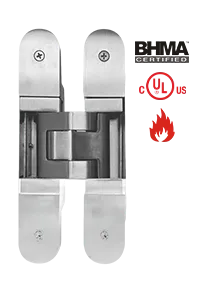
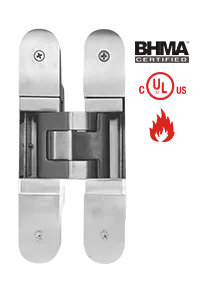
- • 3D adjustable invisible hinge
- • Non-handed
- • Certification: UL10C fire rated, 3 hours
- • Load capacity: 300kg
- • Suitable for wooden doors, steel doors, profile doors, folding doors
- • Minimum door thickness: 45mm
- • Material: Stainless steel 304
- • Finish: SS, PS, AB, PVD
- • 3D adjustable invisible hinge
- • Non-handed
- • Certification: UL10C fire rated, 3 hours
- • Certification (Pending): EN1935; EN1634-1, fire-rating
- • Load capacity: 200kg
- • Suitable for wooden doors, steel doors, profile doors, folding doors
- • Minimum door thickness: 45mm
- • Material: Stainless steel 304
- • Finish: SS, PS, AB, PVD
- • 3D adjustable invisible hinge
- • Non-handed
- • Certification: UL10C fire rated, 3 hours
- • Certification (Pending): EN1935; EN1634-1, fire-rating
- • Load capacity: 120kg
- • Suitable for wooden doors, steel doors, profile doors, folding doors
- • Minimum door thickness: 35mm
- • Material: Stainless steel 304
- • Finish: SS, PS, AB, PVD
- • 3D adjustable invisible hinge
- • Non-handed
- • Certification: UL10C fire rated, 3 hours
- • Certification (Pending): EN1935; EN1634-1, fire-rating
- • Load capacity: 60kg
- • Suitable for wooden doors, steel doors, profile doors, folding doors
- • Minimum door thickness: 35mm
- • Material: Stainless steel 304
- • Finish: SS, PS, AB, PVD
- • 3D adjustable invisible hinge
- • Non-handed
- • Certification: ANSI/BHMA A156.1, Heavy Weight Grade 1 (1 000 000 cycles); ANSI/BHMA A156.1, Double Weight (200 000 cycles); UL10C fire rated, 3 hours
- • Load capacity: 80kg
- • Suitable for wooden doors, steel doors, profile doors, folding doors
- • Minimum door thickness: 35mm
- • Material: Stainless steel 304
- • Finish: SS, PS, AB, PVD
How Do You Install and Maintain Stainless Steel Concealed Door Hinges?
Correct installation is essential to the performance of concealed hinges. Even a well-made hinge can operate poorly if the recess is inaccurate, the frame lacks sufficient support or the mounting screws are unsuitable.
Check compatibility: Confirm that the hinge is suitable for the door material, dimensions, thickness and intended opening direction.
Prepare the recesses: Follow the manufacturer's dimensional drawings and machining instructions. Accurate positioning helps prevent binding and uneven gaps.
Secure the hinge: Use appropriate fasteners and ensure that both the door and frame provide adequate mounting support.
Adjust the door: Use the specified adjustment mechanism to correct alignment within the permitted range. Avoid forcing the linkage beyond its design limits.
Inspect operation: Open and close the door several times, checking for interference, unusual noise, loose fasteners and uneven gaps.
How do I install stainless steel concealed door hinges? The exact procedure depends on the hinge model and door construction, so the manufacturer's installation instructions should always take priority over general guidance.
Routine maintenance is straightforward. Clean stainless steel surfaces with a suitable mild cleaner and a soft cloth, then rinse and dry them where appropriate. Avoid steel wool, harsh chemicals and cleaning residues that may damage the surface or introduce contamination. Inspect fasteners, alignment and moving components periodically, and lubricate the mechanism only as recommended by the manufacturer.
Stainless steel concealed hinges for fire doors require additional care in product selection. Can stainless steel concealed hinges be used on fire doors? Yes, but the hinge must be suitable for the specific fire-door assembly and supported by the applicable test evidence or certification. Material alone does not establish fire-door compliance.
Contact Camax to Discuss Your Concealed Hinge Project
Selecting the right concealed hinge starts with the door, not simply the material. Door weight, dimensions, installation conditions and the surrounding environment all influence the final specification.
If you are sourcing stainless steel concealed door hinges for commercial doors, architectural projects or your own hardware brand, Camax can discuss your requirements through its OEM and ODM services. Send your drawings, door specifications, estimated order quantity and customization needs for a technical review.
Need help? Contact Camax for a quote!
Discover Camax's door & window hardware with ANSI/BHMA/UL/CE certification today!