


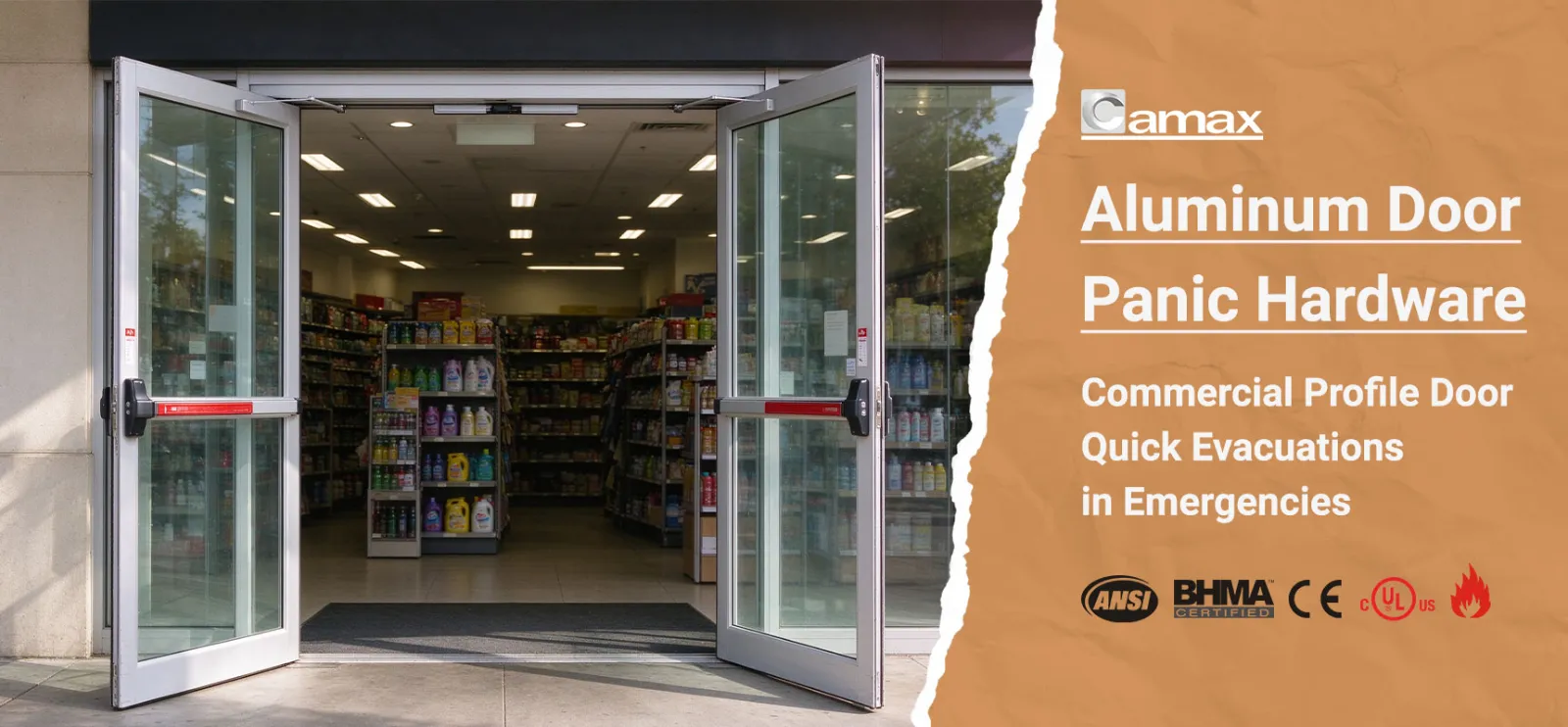
Aluminum storefront doors are common in retail buildings, offices, schools and commercial entrances. Their slim profiles and large glass panels create a clean appearance, but they also leave less room for locking hardware than many traditional wood or hollow metal doors. Choosing an exit device based on appearance alone can lead to problems with mounting space, latch alignment and door preparation.
The right aluminum door panic hardware must suit the door profile, opening configuration and intended use. A device that works well on a wide-stile door may not fit a narrow aluminum extrusion, while a fire door may require a specifically listed hardware assembly. This guide compares the main types of panic exit devices, outlines the standards buyers should check, and explains what to consider when sourcing products for commercial projects. It also covers OEM and ODM options for companies developing their own door hardware ranges.
Table of contents
Why Aluminum Doors Need Suitable Exit Hardware
Aluminum doors are built around extruded profiles rather than a single solid slab. The available internal space varies by system, and narrow-stile doors leave particularly little room for a lock case, fasteners and operating components. Before selecting a panic exit device for aluminum door applications, confirm the actual profile dimensions and the hardware manufacturer's minimum stile requirements.
Fixing strength is another consideration. Thin-walled extrusions may not provide sufficient support for every screw arrangement, especially where the door is subject to frequent use. Depending on the door system and device design, reinforcement, backing plates or specified through-bolting may be necessary. The door manufacturer's instructions should determine the approved fixing method.
Finish compatibility also deserves attention. Anodized aluminum, painted profiles and stainless steel hardware have different surface characteristics. In damp or corrosive environments, contact between dissimilar metals can contribute to galvanic corrosion if the materials and protective measures are unsuitable. Specify compatible finishes and follow the hardware supplier's installation guidance.
Finally, poorly aligned latches, loose fasteners and vibration can create rattling or unreliable engagement. These problems are not unique to aluminum, but lightweight profiles and limited fixing space can make them more noticeable. Correct door preparation and a compatible device are more effective than trying to solve these issues after installation.
Types of Panic Hardware for Aluminum Doors
Many commercial aluminum doors use narrow-stile exit devices because their compact design accommodates restricted mounting areas. The best option depends on whether the door is a single leaf or part of a pair, how it latches, and whether concealed hardware or external access is required.
1. Rim Panic Devices for Single Aluminum Doors
A rim exit device mounts on the interior face of the door. When the push bar is operated, its latch retracts from a strike mounted on the frame or an approved mullion arrangement. This configuration is widely used on single-leaf storefront doors because the mechanism is comparatively straightforward and the installation does not require concealed vertical rods.
A rim exit device for aluminum door applications is a practical starting point when the opening and stile dimensions suit the model. A narrow stile rim exit device for aluminum door installations must still be checked against the profile width, fixing positions and strike geometry. One detail specifiers sometimes miss is the clearance required around the latch and strike when the door is adjusted or replaced.
Camax manufactures rim panic exit devices for commercial door applications, including solutions for aluminum doors. With OEM and ODM services available, Camax can work with distributors and project buyers to evaluate product configurations based on door profile dimensions, locking requirements and project specifications.
- • Narrow Stile Crossbar Exit Device
- • Handed
- • Certificate: EN1125, categoery 3; EN1634-1, 2-hour fire rated
- • Optional: Pullman latch with invisible fixing screws
- • Material: Stainless steel, Steel, Plastic
- • Finish: Stainless steel satin, Silver painted, Polishing, PVD, Black, Red
- • Narrow Stile Door Exit Device
- • Non-handed
- • Compliance: ANSI/BHMA A156.3 grade 1; UL10C, 3-hour fire rating
- • Material: Stainless steel, Steel, Aluminum
- • Modular design, more than 4-point locks are available. Security anti-thrust latch.
2. Mortise Panic Devices for a Cleaner Profile
A mortise exit device operates a lock case fitted into a prepared pocket within the door stile. The integrated mechanism can provide a compact appearance and a locking arrangement suited to the project. However, it requires compatible door preparation and sufficient space for the lock body and associated components.
When specifying a mortise exit device for aluminum door applications, confirm the lock case dimensions, backset, latch position and profile design before ordering. A narrow stile mortise exit device for aluminum door projects may have more restrictive dimensional requirements than a conventional mortise lock. Do not assume that an existing cutout will accept a different model without modification.
Camax manufactures mortise panic exit devices for commercial door systems, offering options for projects that require an integrated mortise locking mechanism. Through OEM and ODM cooperation, Camax can discuss product requirements with customers, including lock case dimensions, door preparation and functional configurations, to help identify a suitable solution for the intended aluminum door system.
- • Mortise Exit Device for Narrow Stile Door
- • Non-handed
- • Compliance: EN1125; EN1634-1
- • Material: Stainless steel, Steel
- • Finish: Stainless steel satin, Silver painted, Polishing, PVD, Black, Red
3. Vertical Rod Devices for Paired Doors
Vertical rod devices secure doors at the top and bottom, making them suitable for some paired door applications without a center mullion. Surface mounted designs use visible rods and require sufficient clearance for proper operation. Concealed vertical rod devices hide the rods inside the door, offering a cleaner appearance for selected aluminum glass door systems.
When choosing a surface mounted panic bar for aluminum door applications or a concealed vertical rod exit device aluminum door configuration, check the door profile, meeting stile, frame conditions and available space. Confirm compatibility with the door manufacturer before ordering, as concealed systems may require specialized preparation and maintenance.
Camax manufactures vertical rod panic exit devices in surface mounted and concealed configurations for suitable commercial door applications. These options can be considered for paired aluminum doors where the door construction and locking arrangement support their use. Camax also offers OEM and ODM services to help customers assess configuration requirements, including rod placement, latching points and compatibility with the specified door profiles.
- • Concealed Vertical Rod Exit Device
- • Non-handed
- • Compliance: ANSI/BHMA A156.3 grade 1; UL10C, 3-hour fire rated
- • Material: Stainless steel, Steel, Aluminum
- • Finish: Stainless steel satin, Silver painted, Polishing, PVD, Black, Red
- • Concealed Vertical Rod Exit Device with Panic Bar
- • Non-handed
- • Certificate: EN1125; EN1634-1, fire rated
- • Material: Stainless steel, Steel, Plastic
- • Finish: Stainless steel satin, Silver painted, Polishing, PVD, Black, Red
Tips: Narrow-Stile and Wide-Stile Exit Devices
Stile width decides which devices are on the table. A panic exit device for narrow stile aluminum door openings has to work inside a limited footprint, so the housing is slimmer and the trim choices fewer. You can still get a panic bar for narrow stile aluminum door openings, but it accepts less outside trim than a wider version. Where there is room, a surface mounted panic bar for aluminum door openings offers more lever, pull and cylinder options, and if the entrance must carry a panic exit device with outside trim for aluminum door hardware, confirm that trim range before the doors arrive.
A panic bar for narrow stile aluminum door applications should be selected using the product's published dimensional requirements, not the appearance of a product photograph. For a panic exit device for aluminum glass door projects, also check the glass position, rail dimensions, fixing points and door system limitations. Outside trim, where required, must be compatible with both the exit device and the available mounting area.
Codes and Standards to Check Before Ordering
Compliance should be established before the product is selected, not after installation. The applicable requirements depend on the destination market, building use, door function and whether the opening forms part of a fire-rated assembly.
In the United States, UL 305 addresses panic hardware, while ANSI/BHMA A156.3 covers exit devices and includes performance classifications. Grade 1 and Grade 2 represent different performance levels under the relevant standard. Buyers should check the applicable edition, test documentation and the requirements of the project rather than interpreting a grade as a guaranteed service life.
Fire-rated openings need particular care. A fire rated panic exit device for aluminum door applications must be approved for the intended door assembly and installed in accordance with its listing. Dogging, which holds the latch retracted, is generally not permitted on fire exit devices where it would compromise the required latching function. Always confirm the exact product configuration and listing.
NFPA 101 and the International Building Code set out when an exit device is required at all, based on occupant load and occupancy type. If you export rather than specify domestically, swap these references for the local equivalent. Europe uses EN 1125 for panic devices and EN 179 for emergency devices, so a device that is legal in one market may not carry the right certification in another.

What to Check When Sourcing Panic Hardware
A product quotation is easier to evaluate when the technical requirements are clear. Use the following checklist when comparing suppliers or preparing an inquiry for aluminum door panic hardware.
Door construction: Provide the profile type, stile width, door thickness, dimensions and single or paired configuration.
Device mechanism: Identify whether a rim, mortise, surface vertical rod or concealed vertical rod device is required.
Materials and finish: Confirm exposed material, corrosion resistance, finish options and compatibility with the door profile.
Handing and latching: Check handing, latch arrangement, strike requirements and any special door preparation.
Outside access: Specify whether a panic exit device with outside trim for aluminum door applications needs a lever, pull, key cylinder or another approved access function.
Compliance documents: Request relevant listings, test reports and installation instructions for the intended application.
Commercial terms: Compare warranty coverage, spare parts, packaging, lead time, minimum order quantity and customization costs.
Providing drawings or photographs of the existing door can help a supplier assess compatibility more accurately. Where the project has strict compliance requirements, share the relevant specification before requesting a final quotation.
OEM and ODM Solutions for Your Aluminum Panic Hardware Brand
Distributors, importers and door hardware brands often need products that fit their market requirements without developing every component from the beginning. Working with a manufacturer that supports OEM and ODM projects can make it easier to coordinate product specifications, branding and supply arrangements.
With OEM services, customers can source established product designs under their own brand, subject to the agreed specifications and manufacturing arrangements. This approach can suit businesses expanding an existing range of commercial door hardware or supplying products to a defined distribution network.
ODM services may involve a broader product development process. Depending on feasibility, customers can discuss design adjustments, tooling requirements, finish choices, outside trim, packaging and branding. Customization should be reviewed against the intended door application, production volume and any certification implications. Changes to a tested or listed product may require additional assessment and must not be assumed to retain the original approval.
Camax manufactures commercial door hardware and provides OEM and ODM services for business customers. For buyers sourcing a panic exit device for aluminum door projects, the starting point is a clear specification. Share the door profile, required device type, functional options, target market and estimated quantity so the team can evaluate the available manufacturing options.
Looking for an OEM or ODM Panic Hardware Supplier?
The right exit device starts with the door, the required function and the standards that apply to the project. Whether you are sourcing rim, mortise or vertical rod configurations, a clear specification helps reduce compatibility issues and makes supplier evaluation more straightforward.
Camax manufactures aluminum door panic hardware and supports full OEM and ODM programs, from prototype through volume production. Send us your door profile and opening schedule and we will come back with the device that fits.
>> Contact Camax to Discuss Your Project
Need help? Contact Camax for a quote!
Discover Camax's door & window hardware with ANSI/BHMA/UL/CE certification today!