


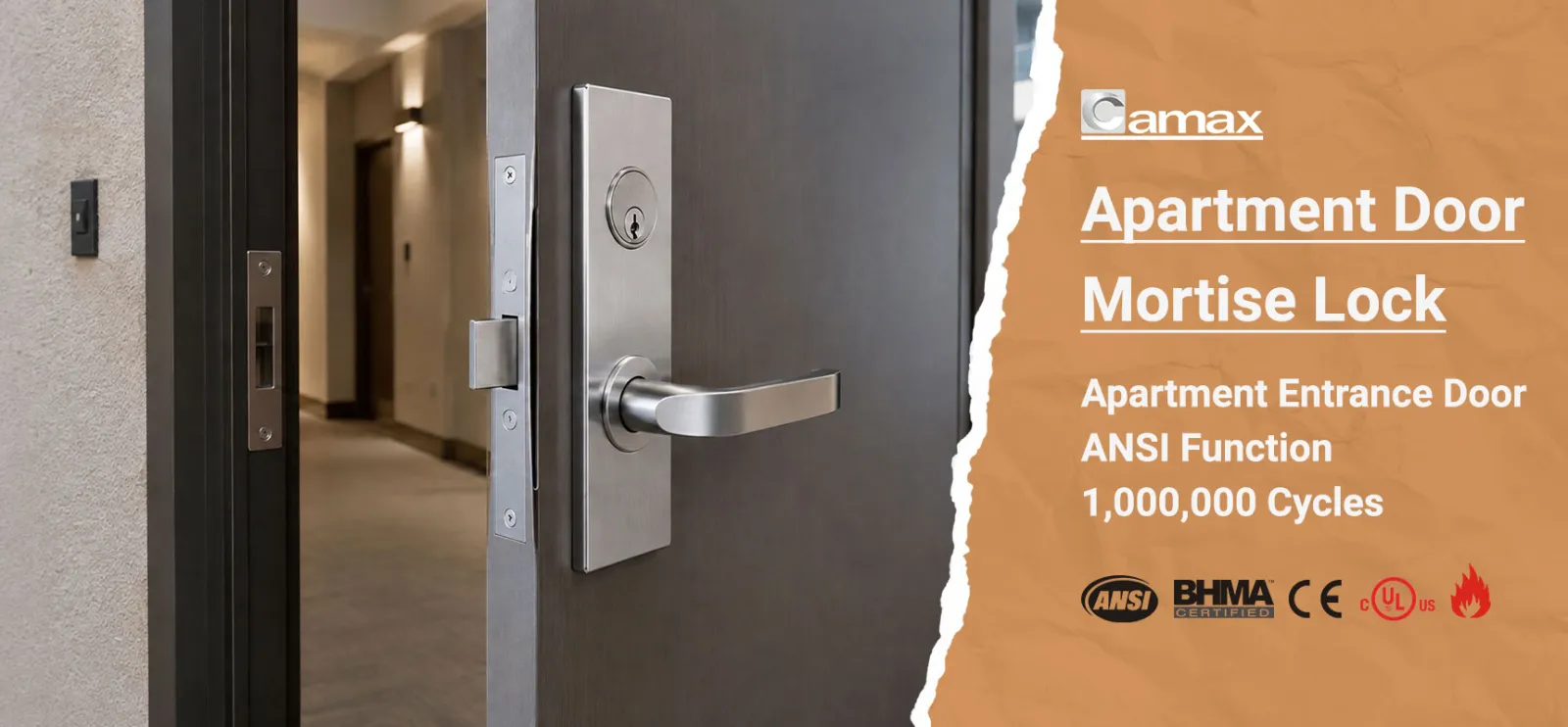
An apartment entrance door needs a lock that provides controlled access without making everyday operation complicated. A mechanical mortise lock is a practical option for this purpose. Installed inside a pocket cut into the door edge, it combines the locking mechanism and operating components in one lock case. Depending on its function, the lock can allow access by lever handle, restrict the outside lever with a key, or provide additional locking through a separate deadbolt.
For apartment buildings, the choice involves more than the appearance of the handle or the type of key. When choosing a mortise lock for apartment entrance doors, we need to consider the required locking function, door construction, backset, lock dimensions, durability, and applicable fire-door requirements. This guide focuses on mechanical mortise locks rather than electronic or smart locking systems, with Camax's CML809 apartment entrance lock as a product example.
Table of contents
What Is a Mechanical Mortise Lock for an Apartment Entrance Door?
A mortise lock is fitted into a recessed pocket, known as a mortise, prepared in the edge of a door. Unlike a cylindrical lock, which is installed through a round hole in the door, a mortise lock uses a rectangular lock case that houses its operating mechanism. The handle, cylinder, and other compatible door furniture connect to this case.
A mortise lock for an apartment entrance door is designed around the access requirements of a residential entrance. Its function determines how the door can be opened from inside and outside, when the exterior handle can be operated, and whether a key or thumbturn is required.
Lock body: The metal case fitted inside the door. It contains the mechanical parts responsible for operating the latch and, where included, the deadbolt.
Latchbolt: The spring-loaded bolt that projects from the door edge and engages with the strike when the door closes. Operating the lever handle retracts it.
Deadbolt: A separate locking bolt, usually operated by a key or thumbturn. It is designed to provide an additional locking point and does not automatically retract like a spring-loaded latchbolt.
Cylinder: The component that accepts the key and transfers its rotation to the lock mechanism. Its compatibility with the lock case and door furniture must be checked.
Lever handle: The operating furniture used to retract the latchbolt. Depending on the lock function, the outside and inside levers may operate differently.
Strike plate: The component fixed to the door frame. It receives the latchbolt and, where applicable, the deadbolt when the door is closed and locked.
Latchbolt vs. Deadbolt: What Is the Difference?
A latchbolt normally retracts when the handle is operated and projects again when released. It keeps a closed door in position during ordinary use. A deadbolt is an additional locking bolt that is generally operated separately by a key or thumbturn. Not every mortise lock includes a deadbolt, so we should check the specific lock function rather than assume that all apartment entrance locks have one.
Why Choose a Mechanical Mortise Lock for an Apartment Door?
Mechanical mortise locks remain a practical choice for apartment entrance doors because their operation is straightforward and their functions can be configured for different access requirements. They do not depend on batteries, wiring, software, or an electronic access controller. This makes them suitable for projects where a conventional key-operated locking arrangement is preferred.
1. Different Locking Functions in One Product Range
A mortise lock platform can be offered in several ANSI functions while retaining a consistent lock case design. Depending on the model, options may include passage, privacy, office, storeroom, entrance, and apartment entrance functions. This gives door manufacturers and hardware distributors more flexibility when specifying locks for different areas of a residential building.
For an apartment entrance, the outside handle may need to be restricted after the door is locked, while the inside handle remains available for normal exit. The exact operation depends on the selected function and should be confirmed before ordering.
2. Mechanical Operation Without Electronic Components
A mechanical apartment door lock operates through its internal components and compatible door furniture. There is no battery to replace or electronic system to configure. For building operators, this can simplify routine maintenance and make the locking arrangement easier to understand.
3. Compatibility With Different Door Hardware
Mortise locks can be used with compatible lever handles, cylinders, and other door furniture. However, compatibility is not automatic. The spindle, cylinder profile, lock dimensions, and door preparation need to match the selected lock. These details are particularly important when a project uses a standard hardware specification across multiple apartment units.

Camax Mechanical Mortise Lock for Apartment Entrance Doors
Camax's CML809 is an apartment entrance lock in the CML800 Series of ANSI commercial mortise locks. It is designed for an entrance function in which the outside lever can be controlled by a key-operated locking arrangement, while the inside lever remains available for operation.
The latchbolt can be operated by the lever from either side. When the outside lever is locked by key from inside, the latchbolt can be retracted from outside with the key or from inside by operating the lever. The lock also incorporates an auxiliary dead latch.
This operating arrangement is intended for apartment entrance applications where controlled exterior access and convenient operation from inside are required.
- • ANSI commercial mortise locks
- • Certificate: BHMA listed; ANSI/BHMA A156.13-2020, Grade 1 (1, 000, 000); UL10C 3-hour fire rating.
- • Lockcase: Heavy-gauge steel, with zinc dichromate finish for corrosion resistance.
- • Deadbolt: One-piece stainless steel, 25mm throw.
- • Latchbolt: Stainless steel, 2 pieces mechanical with anti-friction insert, 19mm throw.
- • Auxiliary Latchbolt: stainless steel.
- • Strike: stainless steel, ANSI straight lip standard 4-7/8" (124mm) x 1-1/4" (32mm).
- • Door thickness: 1-3/4" (45mm) standard. Optional 1-3/8" (35mm), 2-1/2" (64mm).
- • Backset: 2 3/4" (70mm).
| Outside/Inside | SKU | Type | ANSI | Function Description |
|---|---|---|---|---|
 |
CML809 | Apartment Entrance Lock | F09 | Latch bolt operated by lever from either side except when outside lever is locked by key from inside. When the outside lever is locked, the latch bolt is retracted by key from the outside or by operating the inside lever. Auxiliary dead latch. |
The CML800 Series is BHMA listed and certified to ANSI/BHMA A156.13-2020, Grade 1, with a cycle rating of 1,000,000. The series also carries a UL 10C 3-hour fire rating. These credentials provide useful reference points for buyers specifying commercial-grade mortise locks for demanding building applications.
The CML800 Series also includes other lock functions for different applications. We can refer to the Camax ANSI and EN Mortise Lock Catalogue for product information and available configurations.
The lock case is made from heavy-gauge steel with a zinc dichromate finish. Its deadbolt is a one-piece stainless steel component with a 25 mm throw. The two-piece mechanical latchbolt is made from stainless steel, incorporates an anti-friction insert, and has a 19 mm throw. The auxiliary latchbolt and strike are also stainless steel.
The CML800 Series uses a universal lock case with field-reversible handing. The handing can be changed without opening the lock case, which can make installation and project handling more convenient. A locking thumbturn on the inside also provides a visual indication of the lock's locked or unlocked status.
Tips: OEM and ODM Mortise Lock Solutions
Camax manufactures mechanical mortise locks for door hardware brands, distributors, door manufacturers, and project suppliers. In addition to its standard product range, Camax provides OEM and ODM services for customers with specific product or sourcing requirements.
For an apartment door lock project, the initial specification should cover the required ANSI function, backset, door thickness, cylinder arrangement, lever compatibility, finish, and target quantity. Drawings or samples are also useful when a customer needs to match an existing door preparation or hardware specification.
Discussing these details at the beginning helps confirm whether a standard model is suitable or whether further product customization is needed. Camax can work with customers on product specifications, branding, and packaging according to project requirements and manufacturing feasibility.
How Do You Choose the Right Mortise Lock for an Apartment Entrance Door?
A lock may have the correct general function but still be unsuitable for a particular door. Before selecting an apartment entrance door lock, check the following details with the door manufacturer or hardware supplier.
1. Check the Door Material and Thickness
Apartment entrance doors may be made from wood, steel, or other door constructions. The door material affects how the mortise pocket is prepared and how the lock case is secured. Door thickness also determines whether the lock, cylinder, spindle, and lever furniture can be installed correctly. Confirm the permitted thickness range in the manufacturer's specifications.
2. Confirm the Backset and Lock Case Dimensions
The backset is the distance from the edge of the door to the centerline of the handle spindle or operating hub, according to the lock's dimensional reference. It affects the position of the handle and the compatibility of the lock with the prepared door. Also check the lock case height, depth, faceplate dimensions, and strike position before ordering.
3. Select the Required Latchbolt and Deadbolt Function
Decide how the entrance should operate from both sides. Does the outside lever need to be locked by key? Should the inside lever remain operable? Is a separate deadbolt required as an additional locking point? These are different functional requirements, and the selected model must match the intended operation.
4. Check Cylinder and Lever Handle Compatibility
The cylinder and lever handle must be compatible with the lock case. Confirm the cylinder type and dimensions, spindle arrangement, handle fixing method, and any required door furniture. If the project uses a particular hardware range, checking compatibility before production can prevent installation problems later.
5. Consider Durability and Testing Requirements
Apartment entrance doors are used regularly, so the lock should be selected with the expected operating frequency and project requirements in mind. Look for documented performance ratings and relevant certification. A Grade 1 rating under ANSI/BHMA A156.13, for example, provides a recognized performance reference for mortise locks. Always check the applicable standard and certificate for the actual model being purchased.
Can Mechanical Mortise Locks Be Used on Fire-Rated Apartment Doors?
Yes. Mechanical mortise locks can be used on fire-rated apartment entrance doors when the specific lock model is approved for the intended fire-door assembly and installed according to the relevant requirements.
A fire rating should never be assumed from the lock's material, appearance, or mechanical construction. Compliance depends on the tested or approved configuration, including the door, frame, hardware, preparation, and installation conditions. The lock's documentation should therefore be checked alongside the fire-door manufacturer's requirements.
Camax's CML800 Series carries a UL 10C 3-hour fire rating. For a project involving fire-rated apartment entrance doors, we should confirm that the CML809 model and the proposed door assembly are covered by the relevant listing and installation conditions. Local building regulations and project specifications must also be followed.
Contact Camax to Choose a Mortise Lock That Matches Your Apartment Door Requirements
Selecting a mortise lock for an apartment entrance door involves more than choosing a lock with a suitable appearance. The locking function, door dimensions, backset, cylinder and handle compatibility, performance rating, and fire-door requirements all need to be considered together.
Camax's CML809 provides an ANSI F09 apartment entrance function within the CML800 Series of Grade 1 commercial mortise locks. With its documented dimensions, mechanical operating arrangement, and UL 10C fire rating, it offers a product option for buyers specifying mechanical mortise locks for residential and multifamily building projects.
Looking for a Mechanical Mortise Lock Supplier?
Camax supplies mechanical mortise locks for door manufacturers, distributors, and project suppliers. Contact Camax team for product specifications, catalogue information, samples, or OEM and ODM discussions.
Need help? Contact Camax for a quote!
Discover Camax's door & window hardware with ANSI/BHMA/UL/CE certification today!