

Modern buildings require reliable door hardware that performs under extreme conditions. From hospitals to office towers, many facilities depend on UL-listed door lock systems to maintain fire safety and operational reliability during emergencies. Among the most trusted solutions in commercial construction is the UL-listed mortise lock.
These advanced locking systems are specifically engineered to meet rigorous testing standards. Unlike ordinary UL door locks, a properly certified mortise lock undergoes extensive fire and durability testing before being approved for use in fire-rated door assemblies.
Growing safety regulations around the world are pushing architects, contractors, and building managers to choose certified hardware. A UL-certified mortise lock not only enhances security but also helps ensure compliance with fire door regulations.
If you are planning a commercial building project or sourcing certified door hardware, continue reading this guide to understand how a UL-listed mortise lock works, why it matters for fire doors, and how to choose the right solution for your building.
Table of contents
What Is a UL Listed Mortise Lock?
Underwriters Laboratories (UL) is an independent, not-for-profit safety certification organization with over a century of testing history. A UL-listed mortise lock is a locking mechanism that has been tested and certified by Underwriters Laboratories. The certification confirms that the lock meets strict safety requirements, including fire resistance, operational reliability, and structural performance.
Unlike surface-mounted locks, a UL mortise lock is installed inside a pocket cut into the door. This internal installation provides stronger support and allows multiple ANSI locking functions within a single lock body. Many commercial buildings prefer a UL-listed mortise lockset because of its strength, durability, and compatibility with fire-rated doors.
When people ask what is a UL-listed mortise lock, they are typically referring to a lock that has passed independent testing verifying several important performance factors.
Fire resistance during high temperature exposure
Mechanical durability under repeated use
Compliance with safety standards
Compatibility with fire rated door assemblies
In practical terms, a UL-listed door lock means the hardware has been tested to perform reliably in situations where ordinary locks may fail. This certification is particularly important for buildings where safe evacuation is critical.
What Is UL10C Fire Rated Testing?
Fire-rated doors must perform reliably during extreme heat conditions. One of the most important standards used to evaluate fire door hardware is the UL10C mortise lock testing procedure.
The UL10C test examines how door hardware behaves during a fire scenario. A properly tested UL fire-rated mortise lock must maintain functionality and structural integrity while exposed to high temperatures and pressure conditions.
A certified UL10C fire-rated mortise door lock undergoes several critical evaluations during testing.
Exposure to controlled fire conditions
Positive pressure fire testing
Operational testing after heat exposure
Evaluation of the entire fire door assembly
Many commercial buildings require a UL-listed mortise lock 3-hour rated for high-risk areas. A 3-hour fire-rated UL mortise lock indicates that the hardware can remain functional and structurally stable for extended periods during a fire.
1. Key Differences Between UL Listed and Non-UL Mortise Locks
It can be tempting to save money by specifying non-certified hardware, especially on projects where fire door requirements seem like a formality. But the practical differences between a UL-certified mortise lock and an uncertified alternative are significant — and the consequences of getting it wrong can be severe.
| Feature | UL Listed Mortise Lock | Non UL Lock |
|---|---|---|
| Fire Testing | Certified through laboratory testing | Not independently verified |
| Building Code Acceptance | Accepted for many commercial projects | Often not permitted for fire doors |
| Reliability | Consistent mechanical performance | Varies by manufacturer |
| Safety | Verified under controlled standards | Performance uncertain |
This comparison clearly shows why UL-listed mortise locks are important for safety. Certification ensures that door hardware functions properly when building occupants depend on it the most.
2. ANSI Grade 1 vs UL Listed Mortise Locks
Another common question is what is the difference between ANSI Grade 1 and UL-listed mortise locks. These two standards evaluate different aspects of lock performance.
ANSI testing focuses on mechanical durability. For example, an ANSI Grade 1 UL mortise lock is tested for more than one million operation cycles, demonstrating exceptional durability under heavy traffic conditions.
UL certification focuses on fire safety. A lock tested as an ANSI Grade 1 UL listed mortise lock provides both mechanical strength and fire-rated reliability. Many commercial projects prefer locks that meet both standards to ensure maximum safety and durability.
Why UL Listed Mortise Locks Are Essential for Fire Doors?
Fire-rated doors serve as barriers that slow the spread of flames and smoke throughout a building. For these doors to perform effectively, all hardware installed on them must meet compatible safety standards.
A UL listed mortise lock for fire door ensures that the door assembly remains secure and operational even during high temperature exposure. Without certified hardware, the door system may fail to function as intended.
A properly designed UL-listed fire-rated mortise door lock provides several critical benefits.
Reliable operation during emergency evacuation
Structural compatibility with fire rated doors
Prevention of lock failure under heat exposure
Long term durability for commercial environments
This is why many facilities including hospitals, schools, hotels, and office buildings rely on certified ANSI and UL-listed mortise locks for their entrances and fire-rated doors.
1. Are UL Listed Mortise Locks Required by Building Codes?
In most commercial jurisdictions, yes — though the exact language varies by region and occupancy type.
Standards such as the International Building Code and NFPA 80 outline requirements for fire door assemblies. These regulations frequently specify the use of certified hardware, including UL-listed commercial door lock products.
Facilities such as hospitals and schools often have even stricter safety regulations. This leads many contractors to ask are UL listed mortise locks required for hospital and school doors. In many cases, certified hardware is required to ensure life safety compliance.
2. Where UL Listed Mortise Locks Are Used?
Because of their strength and certification, UL listed heavy duty mortise lock systems are used in a wide variety of door types.
Steel Fire Doors
A UL-listed mortise lock for steel door applications must account for the thermal conductivity of metal. Steel expands and distorts under high heat, which puts stress on the mortise pocket and the latch mechanism. Locks specified for steel doors are tested with this behavior in mind, ensuring the latch retracts and extends reliably even after significant heat exposure.
Timber and Wooden Fire Doors
Wood behaves very differently under fire — it chars rather than conducts heat. A UL listed mortise lock for timber door and UL listed mortise lock for wooden doors applications must be compatible with fire-resistant wood core assemblies, maintaining a tight seal even as the door substrate swells before the char layer forms.
Commercial Entry and Multi-Use Doors
For lobbies, common areas, and high-traffic commercial entries, a UL mortise lock for commercial doors needs to balance security with frequent operation. Heavy-duty construction, corrosion-resistant finishes, and Grade 1 mechanical ratings are standard expectations here.
How to Choose a UL Listed Mortise Lock for Your Building?
Selecting the right hardware requires careful evaluation of several factors. Understanding how to choose a UL-listed mortise lock for my building helps ensure that the door system meets both security and safety requirements.
One of the first considerations is fire rating. Some doors require a UL-listed mortise lock 3-hour rated, especially in areas where extended fire resistance is required.
Door material also influences the choice of lock. Steel doors typically use a UL-listed mortise lock for steel door, while wood doors may require specialized hardware compatible with timber construction.
Security level is another important factor. Many commercial facilities prefer an ANSI Grade 1 UL mortise lock because it provides maximum durability and operational reliability.
Finally, building owners may choose additional functions such as a UL-listed mortise lock with deadbolt to increase protection for main entrances and restricted areas. ANSI mortise locks without deadbolt are also available.
Camax Manufactures Certified UL Listed Mortise Locksets
Camax is a professional manufacturer of commercial door hardware specializing in high performance UL listed mortise lockset solutions. Our ANSI mortise locks are engineered to meet demanding safety requirements for modern commercial buildings.
Each UL-certified mortise lock manufactured by Camax is designed to deliver reliable performance in commercial environments with high traffic and strict safety requirements.
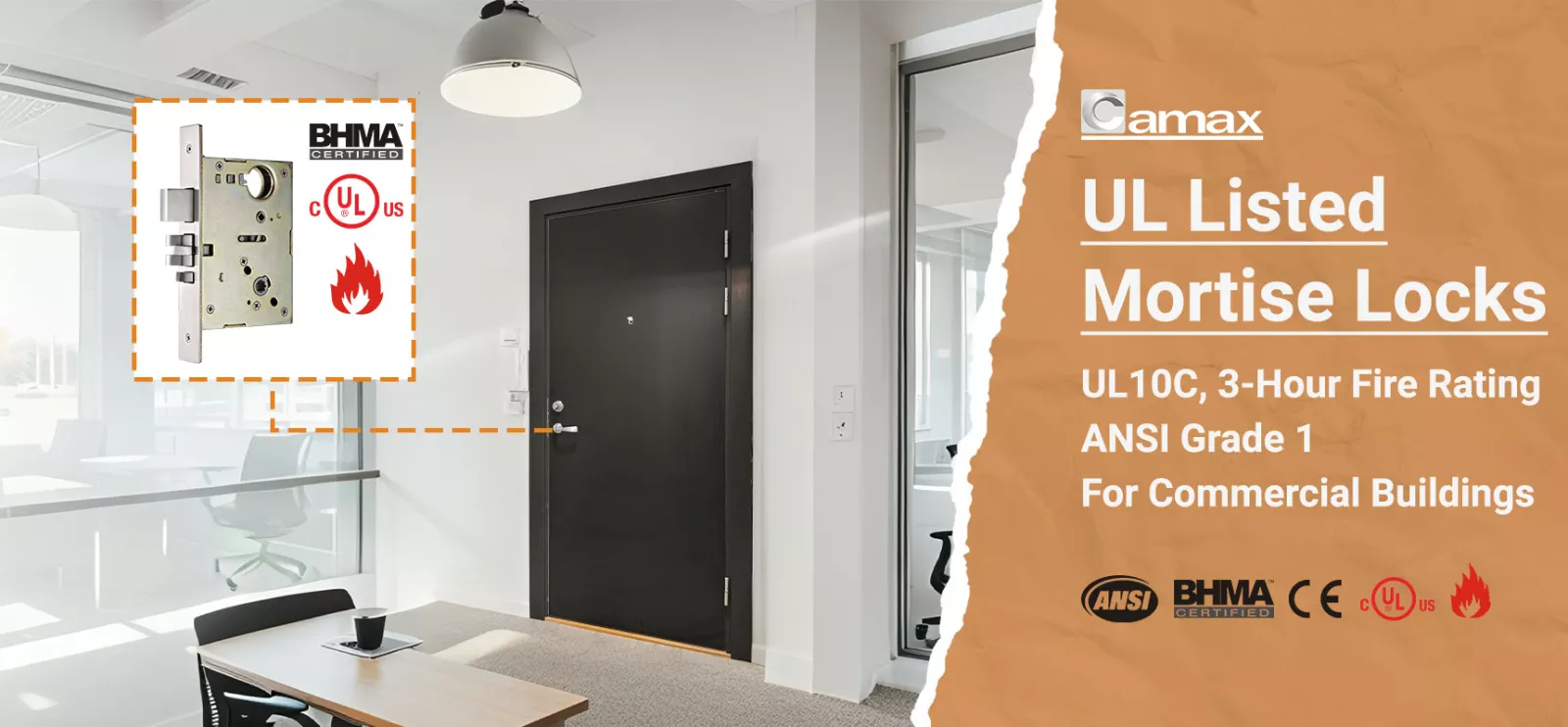
Our locks are tested to meet major international standards including UL10C fire testing and ANSI Grade 1 durability certification. These features ensure that every UL fire-rated mortise lock we produce meets the expectations of architects, builders, and distributors worldwide.
- • ANSI commercial mortise locks
- • Certificate: BHMA listed; ANSI/BHMA A156.13-2020, Grade 1 (1, 000, 000); UL10C 3-hour fire rating.
- • Lockcase: Heavy-gauge steel, with zinc dichromate finish for corrosion resistance.
- • Deadbolt: One-piece stainless steel, 25mm throw.
- • Latchbolt: Stainless steel, 2 pieces mechanical with anti-friction insert, 19mm throw.
- • Auxiliary Latchbolt: stainless steel.
- • Strike: stainless steel, ANSI straight lip standard 4-7/8" (124mm) x 1-1/4" (32mm).
- • Door thickness: 1-3/4" (45mm) standard. Optional 1-3/8" (35mm), 2-1/2" (64mm).
- • Backset: 2 3/4" (70mm).
| Outside/Inside | SKU | Type | ANSI | Function Description |
|---|---|---|---|---|
 |
CML804 | Office and Inner Entry Lock | F04 | Latch bolt operated by lever from either side except when outside lever is made inoperative by thumbturn or key. When the outside lever is locked, the latch bolt is retracted by key from the outside or by operating the inside lever. Auxiliary dead latch. |
 |
CML809 | Apartment Entrance Lock | F09 | Latch bolt operated by lever from either side, except when outside lever is locked by key from inside. When outside lever is locked, latch bolt is retracted by the key from the outside or by operating the inside lever. Auxiliary dead latch. |
 |
CML820 | Entrance Lock | F20 | Latch when outside from either side, except when the outside lever is made inoperative by thumbturn. Deadbolt operated by key outside or turn inside. The key outside operates both bolts. The operating inside lever retracts both bolts and the outside remains locked. The latch bolt is dead-locked when the outside lever is made inoperative or when the deadbolt is projected. When deadbolt is retracted, the lever is unlocked by thumbturn. |
 |
CML801 | Passage Latch | F01 | Latch bolt operated by lever from either side at all times. |
 |
CML831 | Exit or Communicating Lock | F31 | Latch bolt operated by lever from inside. Non-removable blank trim or no trim outside. |
 |
CML802 | Privacy, Bedroom or Bath Lock | F22 | Latch bolt retracted by knob/lever from either side unless outside is locked by inside thumbturn or outside coin turn. Operating the inside knob/lever, closing the door, rotating the inside thumbturn, or rotating the outside coin turn unlocks the outside knob/lever. The inside knob/lever is always free for immediate egress. |
 |
CML802B | Privacy, Bedroom or Bath Lock | F22 | Latch bolt retracted by knob/lever from either side unless outside is locked by inside thumbturn. Operating the inside knob/lever, closing the door, or operating outside emergency release unlocks the outside knob/lever. The inside knob/lever is always free for immediate egress. |
 |
CML819 | Privacy with Deadbolt and Coin Turn Outside | F19 | Latchbolt retracted by knob/lever from either side. Deadbolt thrown or retracted by inside thumbturn or outside coin turn. Throwing deadbolt locks outside knob/lever. Rotating the inside knob/lever simultaneously retracts the deadbolt and latch bolt, and unlocks the outside knob/lever. Rotating the outside coin turn retracts the deadbolt and unlocks the outside knob/lever. Available with rose trim only. The inside lever is always free for immediate egress. |
 |
CML819B | Privacy with Deadbolt and Cylinder Outside | F19 | Latchbolt retracted by knob/lever from either side. Deadbolt thrown or retracted by inside thumbturn or outside CYLINDER. Throwing deadbolt locks outside knob/lever. Rotating the inside knob/lever simultaneously retracts the deadbolt and latch bolt, and unlocks the outside knob/lever. Rotating outside CYLINDER retracts the deadbolt and unlocks the outside knob/lever. Available with rose trim only. The inside lever is always free for immediate egress. |
 |
CML805 | Classroom Lock | F05 | Latch bolt operated by lever from either side except when outside lever is locked from outside by key. When the outside lever is locked, the latch bolt is retracted by key, or by operating the inside lever. Auxiliary dead latch. |
 |
CML829 | Classroom Dead Lock | F29 | Key from outside operates deadbolt. Turn from inside retracts but does not project deadbolt. |
 |
CML807 | Storeroom Lock | F07 | Latch bolt operated by key from outside or by operating inside lever. The outside lever is always inoperative. Auxiliary dead latch. |
 |
CML814 | Store/Utility Room Lock with Deadbolt | F14 | Latch bolt operated by lever from either side. Deadbolt operated by key from either side. |
Tips: Camax OEM and ODM Manufacturing for Global Hardware Brands
In addition to standard products, Camax provides OEM and ODM manufacturing services for global partners. Many hardware distributors and door system brands rely on our production expertise to develop customized mortise lock solutions.
Our manufacturing capabilities include:
Custom mortise lock engineering and development
Private label branding services
Finish and surface treatment customization
Packaging design and branding
Technical product support
Camax mortise locks are widely used in commercial buildings, hospitals, schools, hotels, and office towers where safety, durability, and regulatory compliance are essential.
Contact Camax to Manufacture UL Listed Mortise Locks for Your Commercial Buildings
A UL-listed mortise lock plays a critical role in building safety. These certified locks help maintain fire door integrity, ensure compliance with safety regulations, and provide dependable security for commercial properties.
By choosing a reliable UL-certified mortise lock, building owners can protect occupants while meeting modern construction standards.
Camax offers high-quality UL fire-rated mortise lock solutions designed for global commercial door hardware markets. If you are searching for a trusted manufacturing partner, contact Camax to discuss custom product development, OEM production, and certified mortise lock solutions for your next project.
Need help? Contact Camax for a quote!
Discover Camax's door & window hardware with ANSI/BHMA/UL/CE certification today!