


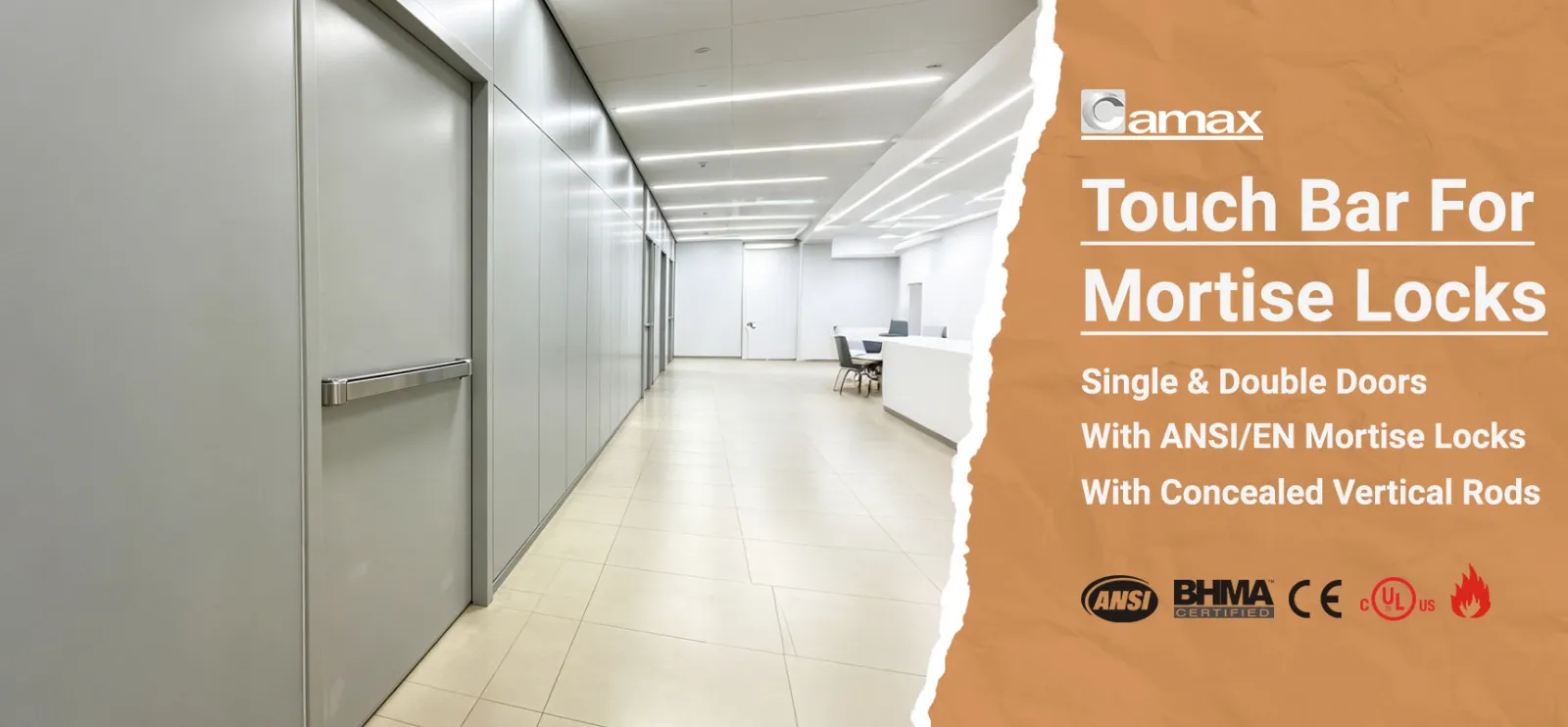
If a room or corridor needs both strong locking and instant egress, a touch bar for a mortise lock is usually the answer. This type of exit device pairs a full width bar mounted across the door with the strength of a mortise lock body, so occupants can leave simply by pressing forward, no twisting, no searching for a handle in the dark. It has become one of the most requested hardware combinations for schools, hospitals, hotels and fire-rated doors because it solves two problems at once: keeping the door properly secured day to day, and making sure it opens instantly the moment someone needs to get out.
In this guide we will walk through what a touch bar for a mortise lock actually is, how the mechanism works from the inside, why so many building owners specify it, and how a manufacturer like Camax supports projects that need this kind of panic exit device for mortise lock applications.
Table of contents
What Is a Touch Bar for a Mortise Lock?
A touch bar for a mortise lock is an exit device where a horizontal bar spans most of the door width and connects directly to a mortise lock body installed inside the door edge. Instead of turning a knob or lever, the occupant just pushes the bar, which releases the latch and lets the door swing open. It is sometimes called a push bar for a mortise lock, and in fire and life safety contexts people also refer to it as a panic touch bar for a mortise lock, since the whole point of the design is to allow fast, low effort exit during an emergency.
A complete assembly generally includes the following parts:
Full width touch bar — the horizontal actuator that runs across the door face, built to respond to a light forward push rather than a pull or twist.
Mortise lock body — housed inside a pocket cut into the door, this is where the actual locking and latching mechanism lives.
Strike — fitted into the frame, it receives the latch bolt and keeps the door firmly closed until it is released.
Latch retraction mechanism — the internal linkage that connects the touch bar's movement to the mortise lock, pulling the latch back the instant the bar is pressed.
The main difference from a standard push bar setup is where the locking function actually sits. A basic push bar often works with a simple rim exit device sitting on the surface of the door. A touch bar built for a mortise lock instead relies on a lock body recessed into the door itself, which generally means better resistance to forced entry, a cleaner appearance, and compatibility with more advanced trim and key cylinder options.

How Does a Touch Bar with a Mortise Lock Work?
The operating sequence is short by design, since the whole idea is speed under pressure. Here is what happens from the moment the door is closed to the moment it is open again:
This cycle is what makes a touch bar exit device so dependable in an emergency. There is no combination of steps to remember, no need to locate a handle in smoke or darkness, and no risk of the door staying unlatched by accident once it closes again.
Why Choose a Touch Bar Exit Device for a Mortise Lock?
Building codes in many regions require panic hardware on doors used by large numbers of people, and a touch bar exit device for a mortise lock tends to check every box that inspectors and facility managers look for.
Faster emergency egress — a single forward push is far quicker than fumbling with a handle, which matters most when a crowd is moving toward an exit at once.
Easy operation for everyone — no grip strength or fine motor control is required, which helps children, elderly occupants and anyone carrying items through the door.
ADA accessibility support — the low operating force and simple push action align well with accessibility requirements common in commercial buildings.
Fire door compatibility — many touch bar and mortise lock combinations are built to work on fire rated openings, helping the door close and relatch reliably every time.
Long service life — the mortise lock body is more rugged than typical surface mounted hardware, so it tends to hold up under years of heavy use.
Built for heavy traffic — corridors, lobbies and assembly areas that see constant door cycling benefit from hardware designed for repeated operation without loosening or sticking.
Camax Touch Bar for Mortise Lock Solutions
Every commercial project has different performance requirements. Door sizes, building codes, traffic volume and architectural preferences all influence the selection of exit hardware. Rather than offering a single standard product, Camax develops flexible touch bar solutions that can be integrated with different mortise locking systems while supporting OEM and ODM customization.
Camax manufactures touch bar for mortise locks that is compatible with multiple commercial door configurations. This compatibility allows distributors, architectural hardware brands and door manufacturers to simplify product selection while maintaining consistent quality across different projects.
- • Touch bar for mortise lock or any concealed vertical rod
- • Non-handed
- • Compliance: EN1125; EN1634-1 fire rated; ANSI/BHMA A156.3 grade 1; UL fire rated
- • Material: Stainless steel, Steel
- • Finish: Satin, Silver, Polishing, PVD, White, Black, Red
1. Compatible with ANSI Mortise Locks
ANSI mortise locks are widely used throughout North America and many international commercial projects because of their robust construction and high security performance. Camax touch bar can be paired with ANSI mortise lock bodies to create dependable exit solutions suitable for office buildings, hospitals, educational facilities and other high-traffic environments.
2. Compatible with EN Mortise Locks
For projects following European standards, Camax also offers touch bar solutions compatible with EN mortise locks. These combinations provide smooth latch retraction and reliable operation while supporting commercial and institutional door systems commonly used throughout Europe and many international markets.
3. Compatible with Concealed Vertical Rod Systems
Many modern architectural projects require a single exit device platform capable of supporting multiple door configurations. Camax touch bar can also be integrated with concealed vertical rod systems, providing a consistent appearance and operating experience across single doors and double door applications.
Beyond compatibility, Camax focuses on the details that determine whether an exit device holds up in the field. That includes one touch operation that stays smooth after years of use, heavy-duty internal components suited to fire-rated applications, and manufacturing tolerances tight enough that the bar does not rattle or bind over time.
For brands and distributors building their own hardware lines, Camax also offers OEM and ODM production, customized touch bar length to match different door widths, a range of surface finishes, private branding, and packaging built around each client's retail or project requirements. Where a specific product line holds UL, ANSI or EN certification, that is confirmed on a model by model basis rather than assumed across the whole catalog, since certifications only apply to the exact configuration that was tested.
Where Are Touch Bars for Mortise Locks Used?
Because the combination balances security with quick release, it shows up across a wide range of building types where both matter equally.
School
Hospitals
Hotels
Airports
Office Buildings
Shopping Malls
Government Buildings
Industrial Facilities
Fire-Rated Doors
In schools and hospitals, the priority is usually rapid, reliable egress for large groups without complicated operation. In hotels and office buildings, appearance and quiet operation tend to carry more weight alongside security. Airports, government facilities and industrial sites often need the added durability of a mortise lock body to withstand constant traffic and stricter security expectations. Fire-rated doors bring their own requirement: the assembly has to close and relatch every single time, since a door that fails to fully secure defeats the purpose of the fire rating altogether.
Partner with Camax Hardware for Reliable Touch Bar for Mortise Locks
A touch bar for a mortise lock brings together two things that are often hard to get in one package: dependable daily security and an exit that works instantly under pressure. The mechanism itself is simple, a push retracts the latch, the door opens, and everything resets automatically once it closes again, but that simplicity is exactly why it holds up so well in real emergencies. Add in the benefits of faster egress, easier operation for a wide range of occupants, fire door compatibility and a long service life, and it becomes clear why this hardware combination is specified so consistently across commercial and institutional buildings.
Camax manufactures touch bars for mortise locks that are compatible with ANSI mortise locks, EN mortise locks and concealed vertical rod systems. Through OEM and ODM services, custom finishes, private branding and tailored packaging, Camax helps architectural hardware brands, distributors and door manufacturers develop exit device solutions that hold up across different markets and building codes.
Contact Camax today to discuss your next commercial exit device project.
Need help? Contact Camax for a quote!
Discover Camax's door & window hardware with ANSI/BHMA/UL/CE certification today!